
Dear mom reading this,
Quick test. Without checking your phone or looking around, can you tell me what’s for dinner tomorrow? What size shoes your child wears right now? When their next vaccine is due?
You probably can. Instantly. Without a list, without trying.
That’s not a good memory. That’s a full-time job running quietly in your mind, one nobody hired you for, and nobody pays you for. It has a name. It’s called the mental load of motherhood.
You haven’t lifted a finger in the last hour, yet some part of you is tired in a way rest alone doesn’t fix. If that sounds familiar, you’re not imagining it. You’re carrying something real, and it deserves to be named.
What Is the Mental Load? A Simple Mental Load Definition
The mental load definition is not as complicated as it may seem to be. It’s the unnoticed and continual mental labour of maintaining a household and children. Not the chores, but noticing, planning, remembering, and deciding that come before them.
But new research confirms what mothers have been saying for years. According to a joint study conducted by the University of Bath and the University of Melbourne, mothers undertake seven of every 10 planning and organising tasks at home, whereas fathers are responsible for less than half. That’s not a minor imbalance. It means mothers carry the majority of the invisible planning work that keeps families functioning.
What It Actually Feels Like, Day to Day
The mental load doesn’t look like anything from the outside. That’s what makes it so hard to explain.
It’s like remembering everyone’s shoe size, favourite snack, and vaccination schedule, all at once, without writing any of it down. When you waking up already tired because your brain was working while you slept.
It’s being in the room but not really there, checking whether the school fees are paid or whether there’s enough rice for dinner. Holly Pinto, therapist at the Center for Mindful Relationships, describes this as “a to-do list running in the back of your mind that rarely goes quiet”.
This isn’t laziness or disorganisation on your partner’s part, or failure on yours. It’s a structure that has quietly asked one person to hold everything in her head. Usually, that person is you.
You May Also Like: 10 Sleep Tips for New Moms That Actually Help
Common Causes Specific to Motherhood
The mental load doesn’t come from nowhere. It builds from a few familiar places.
- You became the default parent.
At some point, it was you who suddenly knew where things were. You are contacted by your teachers first. Even the best of partners wait for you to tell them what to do.
- Society still expects mothers to be the emotional home base.
In a lot of cultures, even today, raising children and being emotionally available is the mother’s responsibility, regardless of her job outside the house.
- Working mothers carry two full loads.
Whether your work is paid or unpaid, it doesn’t replace the mental load; it adds to it. Experts who have studied stay-at-home moms have discovered that it requires a whole new set of skills to do both tasks at the same time, whether visible or invisible.
- Motherhood changes how your brain works.
It’s not just a feeling. Scientific studies in neuroscience have found that this mental burden is a natural part of raising a young child and that it can reshape parts of a mother’s brain involved in caregiving.
Mental Load vs. Burnout: Gently Understanding the Difference
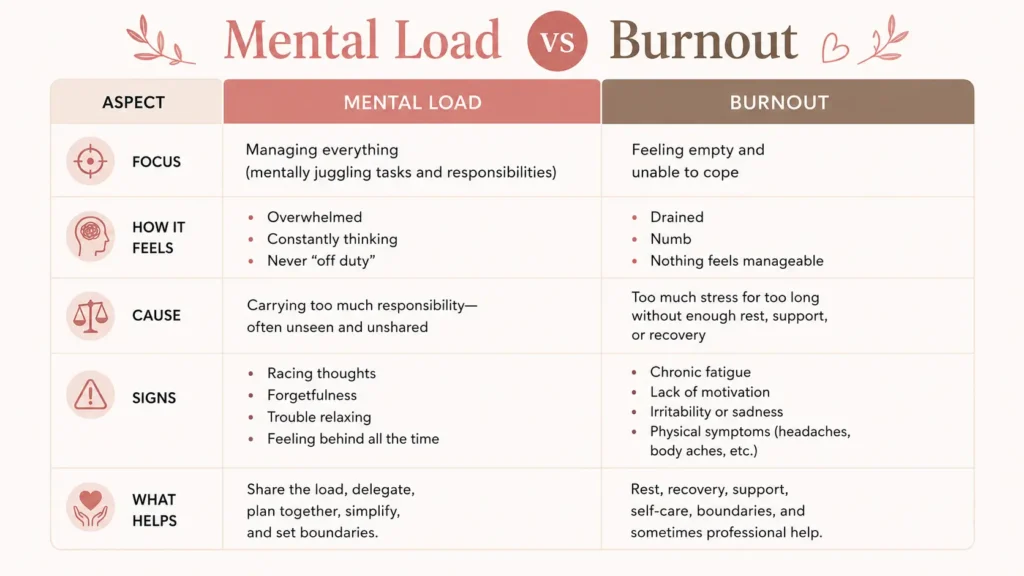
The both are frequently confused, and it’s okay to take a little care in making the distinction without being judgmental.
Mental load is the heavy weight of always having to remember and manage things. Burnout is what happens when you carry that weight for too long without getting a break.
According to psychologists, maternal burnout occurs when the stress is not counterbalanced with recovery, resulting in continuous physical and emotional exhaustion. Ordinary tiredness usually improves after rest. Burnout often doesn’t.
Burnout does not, because it’s a deeper exhaustion that sleep alone can’t repair.
So if you’ve been sleeping enough but still feel hollow, that’s not mean you’re weak. That’s your mental load tipping into something heavier.
Signs that Mental Load Is Affecting You
You might notice you’re short-tempered with your child over tiny things, then feel guilty afterwards.
You might feel disconnected from your partner, not because you don’t love them, but because you’re too depleted to be present.
One licensed counsellor put it simply: a mother can slowly lose sight of herself under the constant weight of everyone else’s needs.
If you’ve caught yourself thinking “who am I outside of this,” that’s a real signal worth listening to.
Physically, the mental load can also show up in the body. Therapists who work with mothers note that ongoing headaches, an upset stomach, and restless nights are common when this kind of exhaustion sets in.
A Mental Load Checklist: Naming What You Actually Carry
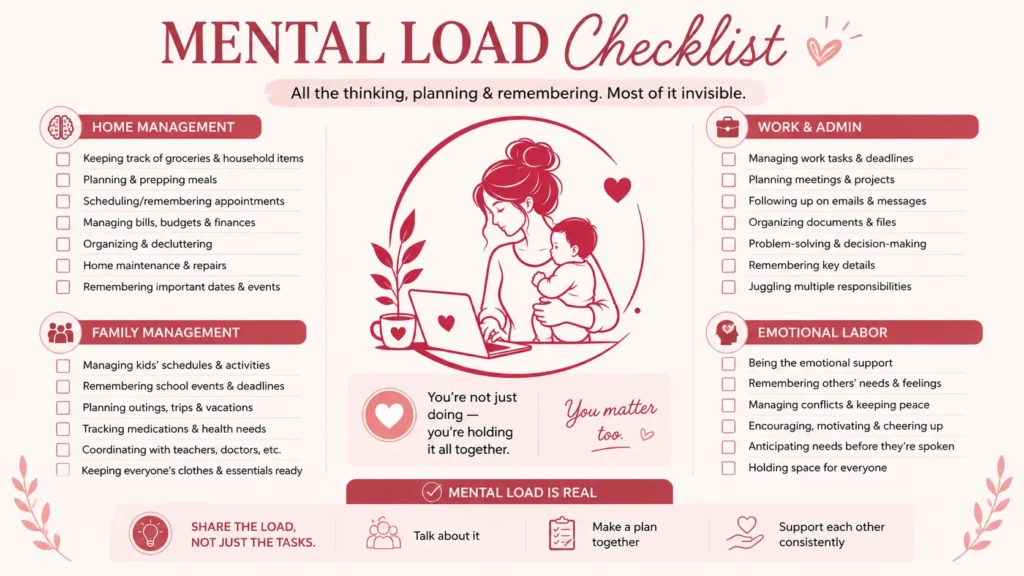
Sometimes the first step to lightening the load is simply seeing it clearly.
Try this mental load checklist for one ordinary day. Ask yourself who in your home is the one who:
- Remembers when the school shoes no longer fit
- Knows what’s missing from the kitchen before it runs out
- Tracks vaccination and doctor appointment dates
- Remembers birthdays, festivals, and needed gifts
- Notices when a child seems off emotionally, before anyone says anything
- Plans meals around everyone’s preferences and allergies
- Keeps track of which forms need to be signed and when they’re due
If most of these fall on you, you’re not overreacting. You’re simply naming what was always there.
How to Explain Mental Load to Your Husband, Without a Fight
You might ask how to explain mental load to your husband without it turning into an argument. This part is delicate, so go gently, both with him and with yourself.
Start with a specific moment, not a general complaint. Instead of saying “you never help,” try something like “I noticed I was the only one who remembered the school trip form this week. Can we share that kind of remembering, not just the doing?”
Ask him to own a full task, start to finish, rather than just helping when asked. A partner who “owns” a task, like managing the children’s clothes or planning weekly meals, carries some of the actual mental load, not just the physical one. Keep the conversation calm and repeated, not a single big confrontation.
Steps Toward Feeling Lighter, Realistic for Your Actual Schedule
No top-to-bottom overhaul is necessary. Small changes are more important than “perfect changes”.
- Take out what you can.
Get things off your mind and into a shared calendar or app that everyone in your family can see. If it isn’t written down, it remains in your brain and is slowly sucking you dry.
- Hand over complete ownership of one responsibility
Choose a specific activity, such as planning groceries or bedtime routines, and give it over to someone else, including the remembering of it!
- Release unexpected expectations that nobody would have ever wanted.
Be honest with yourself and clear about what you want, and your expectations should be clear in your mind.
- Take and enjoy brief moments of relaxation, no matter what you’re doing, without apology.
Any 10 minutes of quiet time, whether it be a nice cup of tea or a walk, is good. Small steps of self-care are seen as valid actions toward recovery, experts say.
- If the weight is too heavy to manage by yourself, consult someone.
When you are feeling exhausted even after resting or feeling disconnected from your children, it is a strength, not a weakness, to reach out to a counsellor or doctor for help.
A Letter Back to You
Here is what I want you to carry with you.
Imagine you’re holding a jug of water all day, every day, for everyone else’s thirst. No one sees the jug. They only see the water appearing, meal after meal, form after form. You’re allowed to put the jug down sometimes. You’re allowed to ask someone else to carry it too.
Tonight, when the list starts running in your head again, try this small ritual. Say quietly to yourself, “I can write this down tomorrow. Right now, I rest.” Then let one thing go undone. The world will still turn.
You are not failing at motherhood. Naming the problem is not complaining. It’s the first act of putting some of that weight down.
With love, a mom who’s been there too.
Frequently Asked Questions
1. What is the mental load in motherhood, in simple words?
The mental load is the invisible thinking work behind running a home, like remembering, planning, and organising everything a family needs. Psychologists place it separately from the visible chores themselves, since it’s the tracking and deciding that happens before any task gets done.
2. How do I reduce my mental load without giving up control?
Start small by writing tasks down somewhere shared, like a calendar or app, so they’re no longer only in your head. Then hand over full ownership, not just help, on one or two specific tasks to someone else in your household.
3. Is the mental load the same as depression?
No, though they can overlap. Therapists explain that unlike ordinary tiredness, mental load doesn’t lift after sleep or a day off, so if low mood or numbness lasts for weeks, it’s worth speaking to a doctor.
4. How can I explain the mental load to my husband without starting a fight?
Use one specific, recent example instead of a general accusation, like a form or appointment only you remembered. Ask him to fully own a task from start to finish, including the remembering, not just the doing when asked.
5. Why do I still feel exhausted even when my partner helps with chores?
Because “helping” with chores is different from sharing the mental load behind them. Someone can wash dishes without ever having to remember that they’re low on dish soap or track everyone’s preferences.
6. What are early signs the mental load is turning into burnout?
Watch for exhaustion that doesn’t improve with sleep, feeling emotionally distant from your children, or losing interest in things that used to bring you joy. Physical signs like frequent headaches and disrupted sleep can also show up.