Walking into a store or scrolling through a hundred tabs, trying to pick a car seat for a baby who has not even arrived yet, can feel overwhelming. Every brand claims to be the safest. Every review says something different.
And on top of that, you are also trying to figure out strollers, cribs, and a dozen other things on your newborn checklist.
An infant car seat is one purchase you cannot afford to get wrong. It is often the very first thing your baby rides home in from the hospital.
This guide walks you through what an infant car seat actually is, why rear-facing matters so much in the early months. How to choose and install one correctly, and the mistakes most new parents do not even realize they are making.
Think of this as your starting point. We will go deeper into specific topics like installation and convertible seats in separate guides, but by the end of this one, you should feel confident enough to make a safe, informed choice.
What Is an Infant Car Seat?
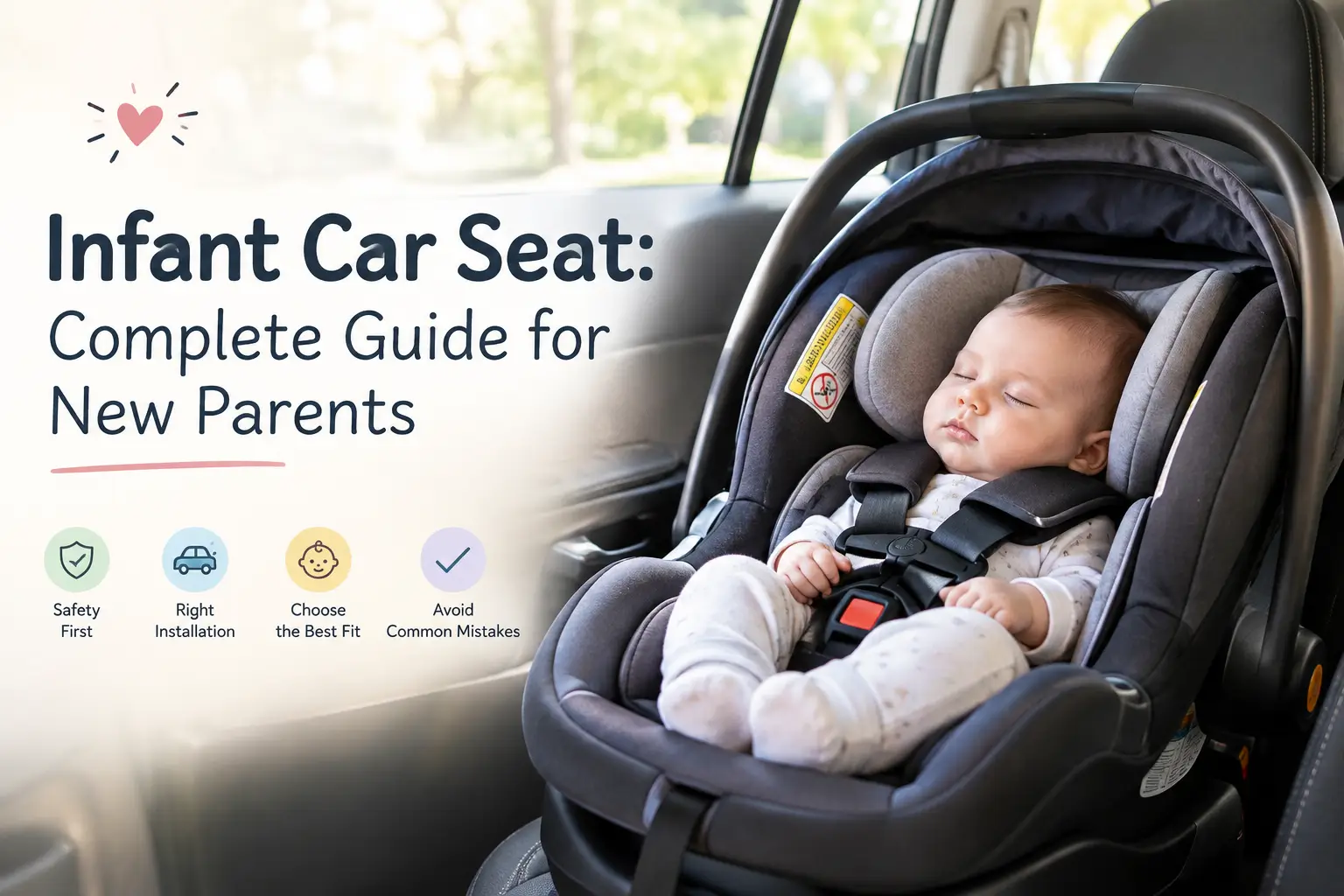
An infant car seat is a small, rear-facing-only seat built specifically for newborns and young babies. Unlike a convertible seat, it is designed to cradle a baby’s proportionally larger head and softer, still-developing neck, usually with extra head and body padding for smaller frames.
Most infant seats also click into a base that stays installed in your car, and many double as part of a travel system. So you can lift the seat out with your sleeping baby still in it and click it onto a stroller frame.
Here is a quick way to see how it compares to the other seat types:
Infant seat: Rear-facing only, best for newborns up to roughly 22 to 35 pounds depending on the model, detachable and stroller-compatible.
Convertible seat: Switches between rear-facing and forward-facing, usable from birth up to a much higher weight, but stays fixed in the car.
All-in-one seat: Covers rear-facing, forward-facing, and booster stages in one seat, built to last several years but bulkier and heavier to move around.
Why Do Babies Ride Rear-Facing?
A newborn’s head makes up a large share of their total body weight, while their neck muscles and spine are still soft and developing.
In a forward-facing seat during a crash, a baby’s head would be thrown forward with nothing but the neck to absorb that force.
In a rear-facing seat, the hard shell supports the head, neck, and spine together and spreads the crash force across the whole seat instead of concentrating it on one small area.
This is why the American Academy of Pediatrics recommends that infants ride rear-facing: the hard shell absorbs most crash force and protects the most vulnerable parts of a baby’s body.
It is not an overly cautious suggestion. It is based on how a baby’s body is actually built at this stage.
How Long Can a Baby Use an Infant Car Seat?
Most infant seats are designed for use from birth until a baby reaches somewhere between 22 and 35 pounds or until they reach another fit requirement specified by the manufacturer, whichever happens first.
That said, weight and height limits vary a lot between brands and models, so age alone should never be your guide.
Some babies may outgrow an infant seat within several months, while smaller babies may continue using it for much longer. Always follow the height and weight limits for your specific seat.
How to Choose the Right Infant Car Seat
Once you know roughly what an infant seat does, choosing one comes down to a short checklist:
Height and weight limits that match how big your baby is likely to get in the first year. Compatibility with your vehicle, since not every seat fits every car the same way.
Installation method you are comfortable with, either the LATCH system or a seat belt. Compatibility with your stroller if you are planning to build a travel system. Harness slots and recline positions that can adjust as your baby grows. A clear expiration date, usually stamped on the seat itself or in the manual. How easy is the seat actually to install and use on a daily basis?
A higher price tag does not automatically mean a safer seat. Every infant car seat sold has to meet the same baseline federal safety standards. So, the real differences usually come down to comfort, ease of use, and how well it fits your specific car and lifestyle.
How to Install an Infant Car Seat Safely
Installation is where most safety mistakes actually happen, which is why we will dedicate a full, detailed guide to it separately. For now, here is the short version.
Follow the car seat and vehicle manuals carefully. Install the seat using either the lower anchors (LATCH) or the vehicle seat belt, according to the manufacturer’s instructions.
Do not use both methods together unless the car seat manufacturer specifically allows it.
For seats following U.S. installation guidance, that should generally move no more than 1 inch side-to-side or front-to-back when tested at the belt path. Always follow your car seat and vehicle manuals first.
Even after doing everything by the book, it is worth having a certified car seat technician check your installation. Many offer free inspections at hospitals, fire stations, or local safety events. A second pair of trained eyes catches small errors that are easy to miss on your own.
Common Infant Car Seat Mistakes
A few mistakes show up again and again with new parents, and most are easy to fix once you know what to look for.
After buckling your baby in, the harness should be snug enough that you cannot pinch any slack in the strap at the shoulder.
The recline angle is another frequent slip, since being too upright can affect breathing for a small baby. Bulky winter coats or snowsuits under the harness are a bigger risk than most parents realize. They compress in a crash and leave the straps too loose to work properly.
Ignoring height and weight limits, using an expired or previously crashed seat, and moving a baby to the next seat stage too early round out the list.
How Long Can a Baby Stay in a Car Seat?
For actual car travel, a car seat is exactly where your baby should be, for short trips and long road trips alike.
The concern is less about the seat during driving and more about what happens once the car stops. Letting a baby stay in the seat for extended periods outside the car. A napping spot at home or a substitute for a crib, is not recommended by pediatric guidelines. Since the semi-upright position can affect a young baby’s breathing over long stretches.
For longer journeys, plan regular breaks so your baby can be taken out of the seat, fed, changed, and given a chance to move.
Follow your pediatrician’s advice for very young babies and any specific travel recommendations from your car seat manufacturer.
When Should You Switch to a Convertible Car Seat?
The clearest sign is simple: your baby has reached the maximum height or weight limit printed on the infant seat. They reach another fit requirement as mentioned by the manufacturer. A less obvious sign is fit.
If your baby’s shoulders are above the highest harness slot, or they seem cramped and uncomfortable even though they are technically within the weight limit, that is also a cue to move on.
Age by itself is not a reliable marker, since babies grow at very different rates.
Car Seat Safety Standards: US, UK & India
Car seats must meet Federal Motor Vehicle Safety Standards, and most seats also offer LATCH in United States. The lower anchors and tethers system built into most vehicles since the early 2000s.
In the UK and across the EU, seats are approved under either the older ECE R44 standard or the newer R129, also known as i-size. It relies more on height than weight for classification.
In India, child restraint systems are governed by the Central Motor Vehicle Rules, with car seats tested against the AIS-072 standard. Current rules require children below a certain height to travel in an appropriate child restraint and prohibit young children from sitting in the front seat.
Since enforcement and specific age or height thresholds can be updated by authorities.Always check the latest government notification or your car seat’s certification label. Don’t rely on older articles, including this one, for the exact current numbers.
Quick Infant Car Seat Checklist
Before every drive, run through this list:
Fit: Your baby’s head, shoulders, and hips sit correctly within the seat.
Installation: The seat does not shift more than an inch at the base.
Harness: Snug enough that you cannot pinch slack at the shoulder.
Recline: Set to the angle recommended for your baby’s age and weight.
Limits: Your baby is still within the seat’s height and weight range.
Expiration: The seat is not past its printed expiration date.
Manual: You have checked both the car seat and vehicle manuals for your specific setup.
Keep this list handy. It works just as well printed out and taped near your car as it does saved on your phone.
FAQs
What age is an infant car seat for?
Infant car seats are built for newborns and typically work well until somewhere between six months and a year, depending on your baby’s growth and the specific seat’s limits.
How long can a baby use an infant car seat?
Until they reach the seat’s maximum height or weight limit, or until the top of their head comes within an inch of the seat’s edge, whichever comes first.
Do infant car seats expire?
Yes. Many car seats have an expiration period set by the manufacturer. Check the seat label or manual for the exact date.
Is an infant car seat safer than a convertible seat?
Both are safe when installed and used correctly. Infant seats are simply designed specifically for newborns, with better fit and portability in the earliest months.
Is LATCH safer than a seat belt?
Neither is inherently safer. Both methods are approved and tested, so use whichever one provides a tighter, more secure installation for your specific vehicle.
Can a baby sleep in an infant car seat?
It is fine for a baby to fall asleep during a drive. Once you are out of the car, move them to a flat sleeping surface rather than letting the seat be their regular napping spot.
Can you use an infant car seat as a carrier?
Yes, that is one of the main advantages of infant seats, since most detach from the base and click onto compatible strollers. Just avoid long stretches of carrying or sitting outside the car.
When should you switch to a convertible seat?
Once your baby outgrows the infant seat’s height or weight limit, or no longer fits comfortably within it, regardless of their exact age.
Conclusion
It is easy to get lost in comparing brands and features, but the core of infant car seat safety comes down to three things: choosing a seat that fits your baby and your car, installing it correctly, and following the manufacturer’s instructions instead of guesswork or hand-me-down advice. Get those three right, and you have already done the most important part of keeping your baby safe on every drive.