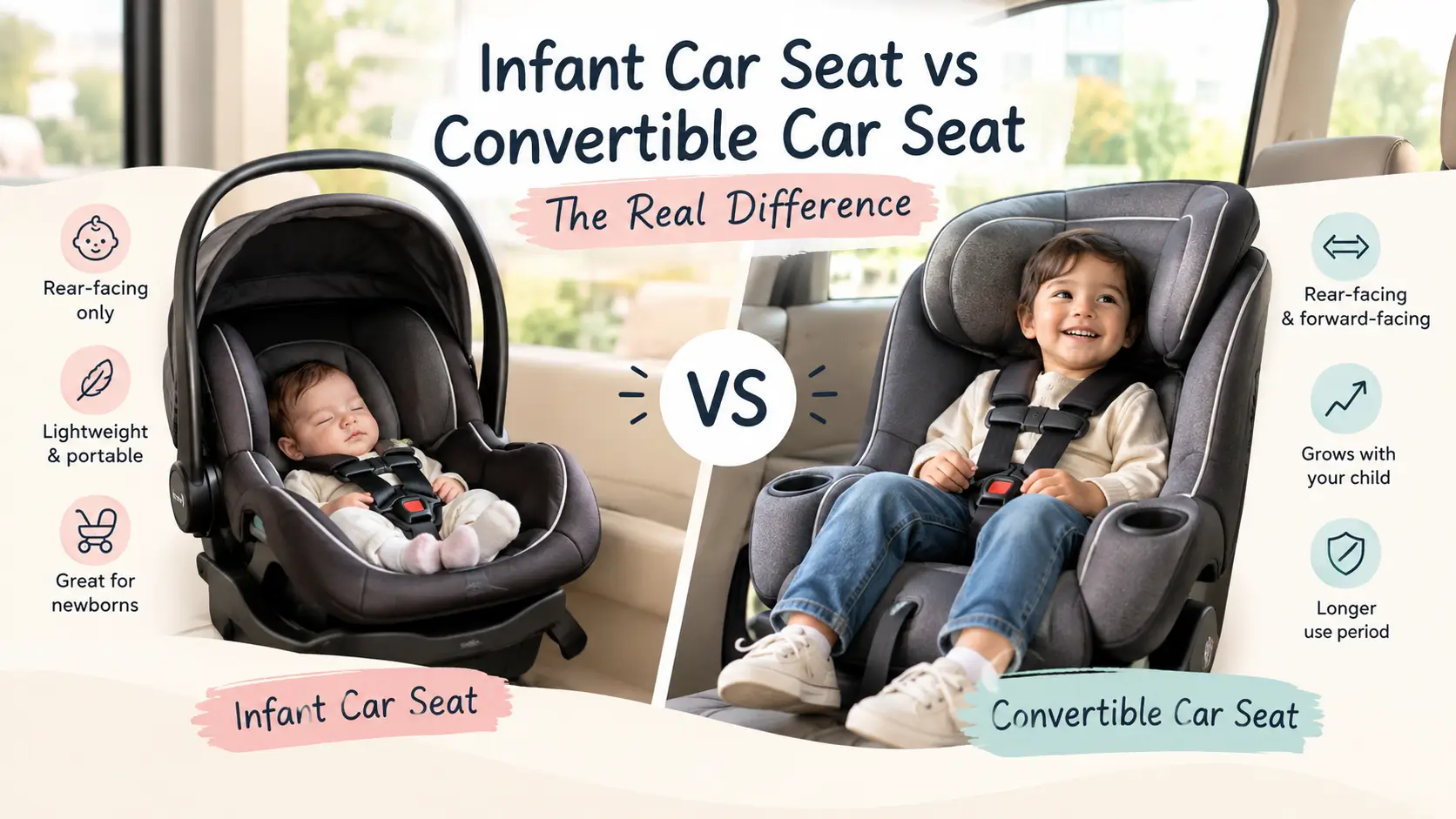
Choosing a car seat can feel confusing, especially when you’re deciding between an infant car seat and a convertible car seat. Both can be safe when used correctly, but they work differently and suit different family needs.
All of them advertise being the best. None of them tell you which one you need.
Let’s change that. No fluff, no fuss — just the straight answer.
What Is an Infant Car Seat
Think of this as a car seat’s starter seat. These are typically smaller, lighter, and only face backwards. You can pop it out of the car and carry it around like a basket. Most have a base you leave in your car that the infant seat snaps in and out of.
Infant car seats are designed specifically for babies and typically provide a more compact fit for newborns. However, the seat must be appropriate for the baby’s height and weight, as specified by the manufacturer’s instructions.
However, you will outgrow this seat pretty quickly. Seats typically cover up to 22 to 35 lbs, and babies usually hit that limit somewhere between 9 and 18 months.
What is a Convertible Car Seat
Now imagine a car seat that grows with your child. That’s a convertible car seat: it grows from rear-facing to forward-facing as your child grows.
Some convertible car seats can be used from birth and continue for several years. Always check the seat’s minimum and maximum height and weight limits.
Unlike the infant car seat, this seat is not meant to be carried around. It sits in your car at all times. This means more lifting for parents when dealing with a sleeping child.
It also takes up more space in your trunk (or wherever you store your car seats). It does, however, save parents the trouble of buying a second car seat.
Infant vs Convertible Car Seat: Quick Comparison
This table will give you a brief review quickly about these two types of car seats.
| Feature | Infant Car Seat | Convertible Car Seat |
| Portability | Removable and designed to be carried | Stays installed in the vehicle |
| Direction | Rear-facing only | Rear-facing, then forward-facing |
| Use period | Until the seat’s height/weight limit | Through multiple stages, depending on model |
| Weight range | Usually up to 22 to 35 lbs | Usually up to 40 to 65 lbs |
| Newborn fit | Designed specifically for infants | Only when the specific model allows newborn use |
| Stroller compatibility | Often compatible with a matching travel system | Generally not designed for stroller use |
| Cost over time | May require another seat later | Can cover more stages with one seat |
| Best for | Parents prioritizing portability | Parents wanting longer-term use |
| Installation | Usually installed with a base or vehicle seat belt, depending on model | Installed directly in the vehicle using the permitted installation method |
| Rear-Facing Limit | Usually lower than convertible | Often allows longer rear-facing use |
As you can see, each seat has its perks. A parent can see which seat to buy based on what floats your boat.
How to Choose Between Them
Before heading out to purchase a car seat, ask yourself these questions:
1. How often do you move your baby around?
If you tend to nap shop, or simply move around a lot, this will affect which seat you choose. An infant seat allows easier movement, letting you pop it in and out while the baby naps in transit. Keep in mind, car seats are meant for travel, not extended sleep, so move your baby to a flat surface once you’re out of the car.
2. Do you want to buy once and forget it?
If you do, it’s better to buy a convertible car seat. Yes, it might cost more, but it eliminates the need to buy a second seat later on. You won’t have to research a third seat either.
3. What does your budget look like?
An infant seat plus a later convertible seat can cost more than one good convertible seat now. Do the math and see what fits your needs best.
4. How much car time does your family have?
Families that tend to drive around more often benefit more from a convertible car seat. They are less of a hassle to install and tend not to require any adjustments between uses. Families that stick to walking may find the portability of an infant seat more useful.
Things Most Guides Never Mention
Now let’s get a little more in-depth than most guides do.
Car seats expire
Yes, car seats do, in fact, expire. Many are meant to last around six to ten years, but check your seat’s label for its exact expiry date.
Extreme temperatures and the sun’s UV rays contribute to the wear and tear of your car seat. Check the expiration date on your car seat to be sure. If unclear, contact the manufacturer with your seat’s model and manufacturing numbers for an accurate answer.
A 3-in-1 seat is not the same as a convertible
Many stores tend to group these two types, but they are in fact different. A 3-in-1 seat supports multiple stages of your child’s growth. Some models eventually convert into a booster seat. A convertible seat generally transitions from rear-facing to forward-facing use.
Configurations vary, so check the manufacturer’s instructions before purchasing.
Rear-facing longer is safer, not just a rule
Many parents tend to turn their children’s seats forward-facing too soon. Children should remain rear-facing as long as possible within their seat’s height and weight limits.
The American Academy of Pediatrics recommends keeping toddlers rear-facing as long as possible to prevent injury.
Rear-facing positioning helps protect a young child’s head, neck, and spine during crashes.
Travel systems can limit your choices.
Some infant seats only attach to a specific brand of stroller. If you happen to own a stroller, make sure the infant seat you’re looking to buy is compatible. This tidbit of knowledge can spare you the trouble of returning a product.
Which One Is Actually Better
There isn’t a single answer to this question. Each seat has its perks and drawbacks; each one is for a specific need or want. The National Highway Traffic Safety Administration finds that a properly installed car seat is always the best option.
Choose an infant car seat if: portability, newborn convenience, stroller compatibility matter.
Choose a convertible car seat if: you want longer use and don’t need to carry the seat outside the car.
Consider both if: you want infant-seat convenience initially and longer-term convertible use later.
All in all, it depends on what a family needs. A proper installation is always the best option for the baby’s safety.
Which Car Seat Fits Your Lifestyle?
| Your situation | Consider |
|---|---|
| Baby often sleeps during short trips | Infant car seat |
| Mostly use your own car | Convertible car seat |
| Use cabs/taxis frequently | Portable infant seat may be more convenient |
| Have two cars | Consider how often you’ll move the seat |
| Want to avoid buying another seat soon | Convertible car seat |
| Walk frequently after driving | Infant seat can be more convenient |
| Have limited car space | Check the exact seat dimensions first |
Before You Buy: Check Your Car, Not Just the Seat
Most parents search for the seat, but the real question is whether that particular seat works with their vehicle.
Check these 5 things:
- Does the seat fit your vehicle’s back seat?
- Does your car support the required installation method?
- Will the front seats still have enough space?
- If buying an infant seat, is the base compatible with your vehicle?
- If you have more than one car, will you move the seat between them?
Always check the manufacturer’s manual to install a seat.
How to Choose a Convertible Car Seat in India
While choosing a convertible car seat in India, you need to remember the points given below, as they are mandatory.
Buying a Car Seat in India
While purchasing a car seat in India, there are three key factors that you need to consider.
First and foremost, you have to ensure that the height and weight of your child fall within the permissible range of the selected car seat.
Secondly, make sure to check how to install the seat in your car. Seats usually come with seat-belt installation guidelines and ISOFIX details, so it is advisable to go through your car’s manual and compare it with the guidelines provided on the product page.
Finally, go through the product description thoroughly to understand the safety standards and certifications applicable to the specific model.
Understand India’s Standards
For the applicable safety standards and certifications in India, you can check out Bureau of Indian Standards’ resources.
Check Seat Material
As we have a tropical climate here in India, look for breathable and machine-washable materials. Avoid aftermarket padding, cushions, or covers unless the manufacturer approves them.
Don’t Overspend
While buying a car seat, it is easy to get tempted by the features and benefits offered in a higher price range. However, we advise you to consider a few factors before purchasing a car seat in a higher price range.
First of all, make sure to calculate how much you actually use your car. If you regularly use more than one vehicle, consider a seat that can be installed easily in each one.
Secondly, make sure that the user category of the selected car seat is applicable to your child. Lastly, make sure to consider the product’s expiry date as recommended by the manufacturer.
FAQs
Can a newborn use a convertible car seat safely?
Many convertible seats are safe for newborns, but not all. Check your seat’s manual for its minimum weight, often around 4 or 5 lbs.
If your baby fits loosely at first, use only manufacturer-approved inserts for a snug fit. Never add towels or padding the seat’s manual doesn’t specifically list.
When should you switch from infant to convertible?
Switch once your child outgrows the seat’s height or weight limit, not a set age. Check your seat’s manual for the exact numbers. Most babies reach that point somewhere between 9 and 18 months.
Is a convertible car seat safe for a 2-month-old?
Yes, as long as your baby meets the seat’s minimum weight and is rear-facing. Check your seat’s manual for the exact minimum before using it. Some convertible seats fit newborns well; others fit better after a few months. Confirm your specific model before relying on it from day one.
Do you really need both an infant and convertible seat?
No, you don’t need both, but many parents prefer them. An infant seat will help greatly in the newborn stage, especially with napping.
A convertible seat will then replace the infant seat, as it will grow with the child for several years. Once again, the right choice depends on your baby’s needs, your vehicle, and how you plan to use the seat.
How long does an infant car seat actually last you?
An infant car seat lasts until your child hits its height or weight limit, usually around 9 to 18 months. The exact number depends on your child’s growth, not their age. You’ll also notice the seat getting heavier and harder to carry as they grow. That’s your cue to move to a convertible seat.
Are convertible car seats harder to install than infant seats?
Not really, but the process is a bit different. A convertible car seat is normally attached directly to the seat belt or LATCH system in your vehicle.
An infant car seat is normally attached using a base. A base is usually attached directly to the vehicle, and the infant seat snaps in and out of this base. Always have your installation checked out by your local safety seat technician.
A Final Thought
Boxes and perks only go so far when it comes to car seats. Choosing a car seat is a personal choice; it’s a choice every parent makes. It’s a choice that reflects the love a parent gives to their child. I hope this article will help in taking a decision.
Happy Reading 🙂