
Choosing your baby boy’s name is one of those little moments that can feel surprisingly big. You want a name that sounds beautiful, carries a meaning you love, and feels right when you imagine calling your little one by it for years to come.
If you’re looking for Japanese boy names that start with K, you’ll find plenty of lovely choices, from familiar names like Kai and Kenji to distinctive options like Kohaku and Kiyoshi.
I’ve gathered Japanese baby boy names with their pronunciations, kanji, meanings, and the kind of feeling each name brings.
You’ll also find a simple, practical way to narrow your choices, whether you speak Japanese, are choosing a name for a mixed-heritage baby, or simply love Japanese names and their cultural significance.
Take your time, say the names aloud, and see which one feels like it belongs to your little boy.
Quick Picks: Japanese Boy Names Starting With K
Kai (海) – Nature-inspired and easy to say. Means “sea” with this kanji. A short, simple choice for an international family.
Kenji (健二) – Classic and familiar. A traditional-style name; this spelling can be interpreted as “healthy” and “second son.”
Kenta (健太) – Strong and grounded. Uses characters associated with health and greatness.
Kaito (海斗) – Modern-feeling and adventurous. Combines “sea” with a character traditionally associated with the Big Dipper.
Kazuki (和希) – Gentle and hopeful. This spelling combines harmony with hope or rarity.
Kiyoshi (清) – Calm and timeless. Means “pure” or “clear,” a classic choice with a peaceful feel.
Kohaku (琥珀) – Distinctive and nature-inspired. Means “amber,” making it a lovely choice if you prefer an uncommon, nature-linked name.
Note: These are meaning-based suggestions, not a verified popularity ranking. Japanese names can have different meanings depending on the kanji chosen.
How Japanese Boy Names Work
Japanese given names are often written using kanji, characters that carry meanings as well as sounds. Some names can also be written in hiragana or katakana, and the same spoken name may have several possible kanji spellings.
For example, Kai can be written as 海, meaning “sea.” Kaito can be written as 海斗, combining “sea” with 斗, a character associated with a measuring vessel and traditionally used in references to the Big Dipper.
That’s why you should look beyond a name’s sound or a single English translation. The exact characters matter, and some combinations have established readings that cannot be reliably guessed from their individual meanings.
Japanese naming traditions also allow considerable creativity in kanji selection, within applicable naming rules. If you’re choosing a Japanese name for your baby, confirm its reading and meaning with a reliable Japanese-language source or a fluent speaker.
Popular & Modern Japanese Boy Names That Start With K
These names are lovely if you want something that feels contemporary while still having a clear connection to Japanese naming traditions.
| Name | Pronunciation | Kanji | Meaning | Vibe / Best for |
| Kaito | KAH-ee-toh | 海斗 | Sea + constellation-associated character | Adventurous and modern |
| Kazuki | KAH-zoo-kee (soft “u”) | 和希 | Harmony + hope or rarity | Gentle and optimistic |
| Kenta | KEHN-tah | 健太 | Healthy, strong + great | Strong and grounded |
| Kota | KOH-tah | 康太 | Healthy + great | Simple and friendly |
| Kazuya | KAH-zoo-yah (soft “u”) | 和也 | Harmony + also/indeed | Warm and easygoing |
| Kazuma | KAH-zoo-mah (soft “u”) | 一真 | One + truth | Confident and composed |
| Kōki | KOH-kee | 光輝 | Light + radiance | Bright and uplifting |
| Keita | KAY-tah | 慶太 | Celebration + great | Cheerful and classic |
| Kanata | kah-NAH-tah | 奏多 | Music/performance + many | Creative and expressive |
Kanji combinations can vary. For Kazuma, 一真 is one possible spelling, and other spellings exist. The meanings listed are tied to the example characters, not guaranteed meanings for every person with that name.
Traditional & Classic Japanese Boy Names Starting With K
If you love names that feel established and timeless, start with these options. Several have multiple traditional kanji spellings, so think about the specific meaning you want to give your baby.
| Name | Pronunciation | Kanji | Meaning | Vibe / Best for |
| Kenji | KEHN-jee | 健二 | Healthy + second | Familiar and traditional |
| Kentaro | kehn-TAH-roh | 健太郎 | Healthy + great + son | Traditional and substantial |
| Kazuo | KAH-zoo-oh (soft “u”) | 和夫 | Harmony + man | Classic and dignified |
| Kiyoshi | kee-YOH-shee | 清 | Pure or clear | Calm and timeless |
| Koji | KOH-jee | 浩二 | Prosperous/abundant + second | Understated and classic |
| Kenichi | keh-NEE-chee | 健一 | Healthy + one | Strong and straightforward |
| Koichi | KOH-ee-chee | 浩一 | Abundant + one | Traditional and composed |
| Kichiro | kee-CHEE-roh | 吉郎 | Good fortune + son | Old-fashioned charm |
| Katsuo | kah-TSOO-oh | 勝男 | Victory + man | Determined and masculine |
| Katsuya | kah-TSOO-yah | 勝也 | Victory + also/indeed | Energetic and confident |
Strong & Brave Japanese Boy Names That Start With K
Would you like your son’s name to carry a sense of courage, resilience, or determination? These options use characters commonly associated with strength, victory, wisdom, or perseverance.
| Name | Pronunciation | Kanji | Meaning | Vibe / Best for |
| Ken | KEHN | 健 | Healthy, strong | Short and confident |
| Katsu | KAH-tsoo | 勝 | Victory | Bold and purposeful |
| Kenshin | KEHN-sheen | 謙信 | Humility + trust/faith | Principled and thoughtful |
| Katashi | kah-TAH-shee | 堅 | Firm or solid | Steady and resilient |
| Katsuhito | kah-tsoo-HEE-toh | 勝人 | Victory + person | Determined and positive |
| Kenzō | KEHN-zoh | 賢三 | Wise + three | Mature and distinctive |
| Keisuke | KAY-soo-keh | 圭介 | Jade-like jewel + help/mediate | Refined and dependable |
| Kōhei | KOH-hay | 康平 | Health + peace | Calm strength |
Kenshin can also be written 剣心, “sword” + “heart,” a spelling many people know from fiction. Choose the spelling that matches the meaning you want.
For a name with an especially clear strength-related meaning, Ken (健) and Kenta (健太) are good places to begin. If you prefer a meaning linked to victory, look at Katsu (勝).
You May Also Like: 25 Japanese Boy Names Meaning Dark (with meanings)
Nature-Inspired Japanese Boy Names Starting With K
Nature-inspired names can bring to mind the sea, trees, flowers, or the sky. If you want a name that feels connected to the natural world, consider these options.
| Name | Pronunciation | Kanji | Meaning | Vibe / Best for |
| Kai | KAH-ee | 海 | Sea or ocean | Short and international |
| Kaito | KAH-ee-toh | 海翔 | Sea + soar or fly | Adventurous and free-spirited |
| Kohaku | koh-HAH-koo | 琥珀 | Amber | Distinctive and earthy |
| Kaede | KAH-eh-deh | 楓 | Maple | Gentle and nature-inspired; unisex |
| Kaoru | KAH-oh-roo | 薫 | Fragrance or fragrant | Soft and elegant; unisex |
| Kō | KOH | 光 | Light | Minimal and bright |
| Kaisei | KAH-ee-say | 海星 | Sea + star | Calm and celestial |
| Kiyoteru | kee-yoh-TEH-roo | 清輝 | Pure/clear + radiance | Bright and traditional in feel |
Kaito appears here with the spelling 海翔 (sea + soar), while the Popular table uses 海斗. Both are real spellings of the same name, which shows how much the kanji choice changes the meaning.
Kaede and Kaoru are used for more than one gender in Japanese. That can be a lovely choice if you prefer a name that isn’t strongly gendered, though you may prefer a more clearly masculine option if that matters to your family.
You May Also Like: Japanese Boy Names That Start With A: Meanings, Kanji & Pronunciation
Short & Easy-to-Pronounce Japanese Boy Names Starting With K
If your family speaks English, Hindi, or another language, a shorter name may feel easier to use every day. These names are relatively compact, although some sounds may still need a little practice.
| Name | Pronunciation | Kanji | Meaning | Vibe / Best for |
| Kai | KAH-ee | 海 | Sea | Easy international choice |
| Ken | KEHN | 健 | Healthy, strong | Simple and direct |
| Kei | KAY | 慶 | Celebration | Elegant and brief |
| Kō | KOH | 光 | Light | Minimal and meaningful |
| Katsu | KAH-tsoo | 勝 | Victory | Short with a strong meaning |
| Kyo | KYOH | 京 | Capital | Distinctive and compact |
| Kazu | KAH-zoo | 和 | Harmony | Soft and friendly |
Remember that Japanese long vowels matter. Kō is written with a macron in formal romanization, while Ko may be used informally. Decide whether you want to retain the macron in your child’s written name or use a simpler spelling on everyday documents.
Unique & Uncommon Japanese Boy Names Starting With K
If you want something less familiar in your community, these names are worth exploring. “Uncommon” here means distinctive to many international readers, not necessarily rare in Japan.
| Name | Pronunciation | Kanji | Meaning | Vibe / Best for |
| Kōdai | KOH-dye | 航大 | Voyage + great | Adventurous and ambitious |
| Katsuhiko | kah-tsoo-HEE-koh | 勝彦 | Victory + boy/prince-associated character | Traditional and formal |
| Kiyohiro | kee-yoh-HEE-roh | 清弘 | Pure/clear + broad | Refined and traditional |
| Kōsuke | KOH-soo-keh | 康介 | Health + help/mediate | Gentle and established |
| Kōtarō | koh-TAH-roh | 康太郎 | Health + great + son | Classic and substantial |
| Kōsei | KOH-say | 康成 | Health + become/achieve | Modern and composed |
| Kyōhei | KYOH-hay | 恭平 | Respect + peace | Polite and calm |
| Kiyotaka | kee-yoh-TAH-kah | 清隆 | Pure/clear + noble/prosperous | Dignified and traditional |
Some of these kanji combinations are plausible name spellings, but they should not be treated as the only or necessarily most common spellings. Have a fluent Japanese speaker verify the intended reading before you settle on one.
You Can Also Check: Japanese Boy Names That Start With M: Meanings, Kanji & Pronunciation
A Note About the Kanji in This List
Japanese names are flexible, and a romanized name alone cannot establish a single meaning. A name such as Kenji can be written 健二, 研二, 賢二, or other ways, changing the interpretation. The same principle applies to many of the names above.
For additional examples and documented name spellings, explore Behind the Name: Japanese names beginning with K.
How to Choose the Right Japanese Boy Name Starting With K
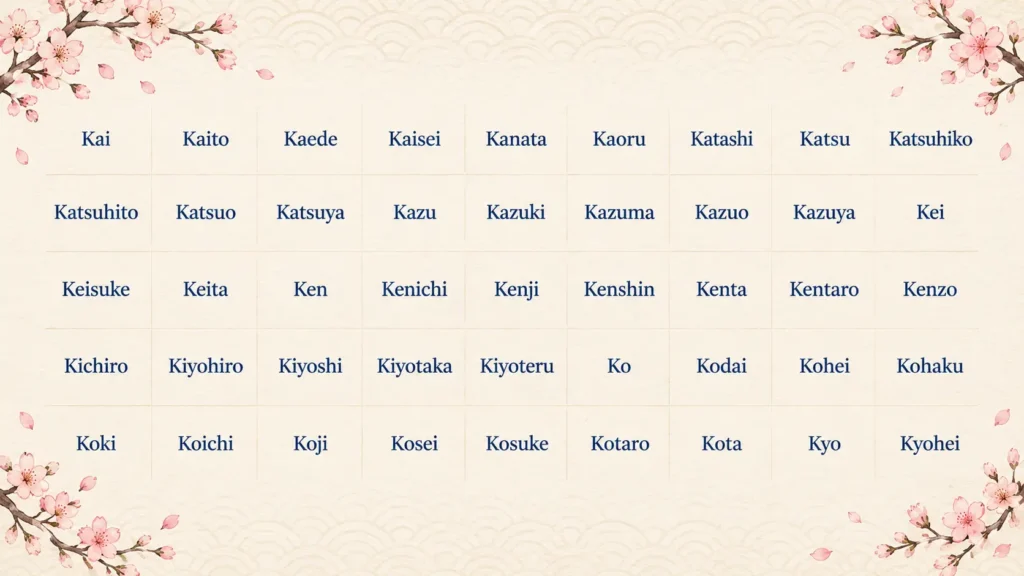
You may have several favorites already, but choosing a name you love on a list is different from choosing one that feels right for your child. Use these steps to narrow your options without getting overwhelmed.
1. Say the name in your own language
Try each name in a normal conversation, when calling your baby from another room, and alongside a surname. If your family speaks English and Hindi, test the name in both, and notice sounds that may be unfamiliar to relatives or friends.
Ask a few people to read your shortlist without coaching them first. Their attempts give you a realistic idea of how the name may be pronounced in your community.
2. Choose the meaning before finalizing the kanji
You might love Kai because you associate it with the sea, or Ken because you want a meaning related to strength. Once you know the idea you want, check the exact kanji.
- Kai (海): sea or ocean
- Kenta (健太): healthy, strong + great
- Kiyoshi (清): pure or clear
- Kohaku (琥珀): amber
Do not assume that every Japanese spelling of a name has the same meaning. If you are choosing kanji for a Japanese legal registration, check that the characters and reading meet the applicable rules.
3. Check for unintended meanings
A name can sound beautiful in one language and create an unexpected association in another. Say your favorites aloud in English, Hindi, and any other language your family uses regularly.
Think about whether the name resembles an awkward word, a common nickname, or a phrase that might invite teasing. You don’t need to anticipate every possible joke, but it is worth catching obvious problems early.
4. Pair it with your surname and imagine the nicknames
A longer surname may pair beautifully with a short name like Kai or Ken. A short surname may give you room to enjoy a longer option like Kentaro. Say the complete name at different speeds and notice the rhythm.
Even if you choose a full name, your family may shorten it naturally:
- Kaito could become Kai.
- Kenji could become Ken.
- Kentaro could become Ken or a family-specific nickname.
- Kazuki could become Kazu among people who know him well.
If you strongly dislike a likely nickname, think about whether you can comfortably guide your family toward another one. Also remember that Japanese naming conventions generally place the family name before the given name, while outside Japan your family may use a different order on official documents.
5. Think about spelling and cultural connection
Names with long vowels may be written with macrons, such as Kōta, or without them, as Kota. The simpler version may be easier on forms and keyboards, but it communicates the original pronunciation less precisely. Decide what matters most to you: preserving the Japanese romanization or keeping spelling straightforward for your community.
If you have Japanese heritage, a name may help connect your child with family history and a language you hope to pass on. If you do not, you can still approach Japanese names with appreciation and respect: learn the correct pronunciation, understand the intended kanji, and consider the cultural context rather than choosing a name solely because it looks fashionable. For a mixed-heritage child, ask relatives from both sides of the family to help you find a name that feels comfortable across cultures.
6. Test five names before making your final choice
Here’s a simple exercise you can try with your partner or family:
- Pick five names from this list.
- Write down the exact kanji, pronunciation, and meaning you intend.
- Say each name aloud with your baby’s surname.
- Imagine using it at home, at school, and in adulthood.
- Put the shortlist away for a few days, then revisit it.
You may find that a name you initially overlooked becomes your favorite after a little time.
If you want X, choose Y
- If you want a short, internationally accessible name, start with Kai.
- If you want a traditional name with a strength-related meaning, consider Kenji or Kenta.
- If you love the sea, explore Kai or Kaito.
- If you want a nature-linked, distinctive name, consider Kohaku.
- If you prefer a soft, unisex option, explore Kaede or Kaoru.
Japanese K Names for Middle Names or Sibling Sets
A Japanese K name can work beautifully as either a first name or a middle name, especially if you’re combining naming traditions from different parts of your family.
For a middle name, try pairing a longer first name with something short:
- Noah Kai – a simple combination with a sea-inspired meaning for Kai.
- Aarav Kai – blends an Indian first name with a short Japanese middle name.
- Ethan Ken – short, easy to say, and straightforward.
- Vihaan Kaito – a longer combination that works across cultures.
- Leo Kazuki – a bright-sounding combination with a harmony-and-hope association for Kazuki (和希).
If you’re choosing names for siblings, consider combinations such as Kai and Kenji, Kaito and Kenta, or Kei and Kohaku. You don’t have to make every name match perfectly. A shared cultural connection, a similar rhythm, or a meaningful theme can be enough.
Before finalizing a middle name, check how the full name looks on official documents and whether the combination feels natural in the languages your family speaks.
Frequently Asked Questions
1. What is the most popular Japanese boy name starting with K?
There isn’t one universally established answer without specifying a year and an official ranking source. Kaito, Kenta, Kenji, and Kazuki are recognizable Japanese masculine given names, but their current popularity can vary by generation. If popularity matters to you, check recent Japanese baby-name statistics rather than relying on a general name list.
2. What does Kaito mean in Japanese?
Kaito has several possible kanji spellings. With 海斗, the first character means “sea” or “ocean,” while the second is associated with a measuring vessel and is used in references to the Big Dipper. With 海翔, the second character means “soar” or “fly.” Choose the spelling that reflects the meaning you want.
3. Which Japanese K name is easiest for English speakers to pronounce?
Kai is a practical starting point because it is short and commonly pronounced KAH-ee. Ken is another compact option, usually pronounced KEHN. Pronunciation varies between accents, so say your favorite name aloud with your surname and consider how it sounds in the languages your family uses.
4. Can a non-Japanese family use a Japanese boy name?
You can consider a Japanese name for your child even if you don’t have Japanese heritage. Take time to learn its pronunciation, understand the meaning of its intended kanji, and appreciate its cultural background. If the name has personal significance to your family, learning about its origins can make your choice more thoughtful and meaningful.
5. What is a strong Japanese boy name that starts with K?
Ken (健) is a strong option because 健 means “healthy” or “strong.” Kenta (健太) combines that character with 太, associated with greatness or largeness. Katsu (勝) is another possibility, with a meaning of “victory.” The exact meaning of a longer name depends on the kanji you select.
6. Are there Japanese boy names starting with K that have nature meanings?
Yes. Kai (海) means “sea” or “ocean”; Kaito can incorporate sea-related kanji; and Kohaku (琥珀) means “amber.” Kaede (楓), meaning “maple,” is also used as a given name for boys and girls. Check the exact kanji because the meaning may differ between spellings of the same name.
7. Do Japanese names have different meanings depending on the kanji?
Yes. The same spoken name may be written using different kanji, and each spelling can carry a different meaning. Kenji, for example, has several established spellings. Before deciding on a name, confirm the exact characters, their intended reading, and the combined meaning rather than relying on the romanized name alone.
8. Should you choose a Japanese name based on its meaning or pronunciation?
You don’t have to choose one over the other. Start with names that sound natural to you, then check their kanji and meanings. If two names feel equally appealing, compare their cultural significance, spelling, pronunciation, and compatibility with your surname. The best choice is one that feels meaningful and practical for your family.
A Little Note Before You Choose
Choosing your baby boy’s name doesn’t have to happen in one sitting. Save your favorites, talk them through with your partner, and permit yourself to change your mind.
Whether you fall in love with the simplicity of Kai, the strength of Kenta, or the distinctive charm of Kohaku, choose a name whose sound and meaning you can feel good about for years to come.
I’d love to know which Japanese boy name starting with K is your favorite. Share it in the comments, or send this list to someone who is searching for a meaningful baby name.
If you are looking for ‘S’ letter names you can check our article for Japanese Boy names starting with S.

2 Comments on “Japanese Boy Names That Start With K: Meanings, Kanji & Pronunciation”