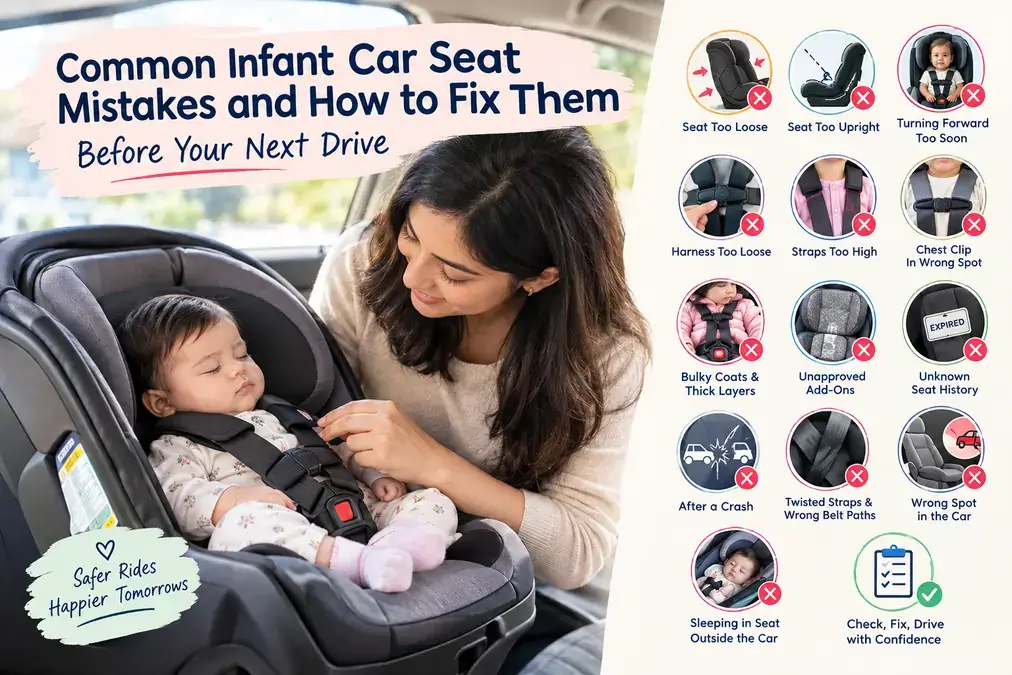
You never expected to turn into an expert on buckles, belts, and angles. And yet here you are, reading about car seats as if you’re studying for an exam. Good.
That tells me how much you care.
What’s funny is the simplicity of a car seat. It’s just a seat with some straps. How hard could it be?
Well, harder than you think, because even the most loving, careful, well-prepared parents make little mistakes. They’re everywhere: in every country, every family.
Picture this. You pull your car into the driveway, lean over the back seat, and take a moment to appreciate your sleeping child. The seat feels snug, the straps are all in place, everything looks good.
The phrase ‘looks good’ and ‘is good’ are not synonyms, though. Luckily for you, most mistakes are easy to fix.
You probably don’t need a degree in engineering or special tools. You just need to know what to look for. So let’s walk through the most common ones together.
Why So Many Car Seats Are Installed Wrong
Before anything else, let’s clear up a misconception. Mistakes aren’t a reflection of your care.
Car seats have long instructions, many parts, and every brand does things a little bit differently. Not to mention that every car is slightly different as well.
Now think back to the installation of your very first seat. You’re tired and emotional and just want to get home. A tiny person is depending on you.
Someone nearby mentions, ‘just click it in’. Nobody has the mindset to read a thirty-page manual in the middle of an emotional moment.
That is why mistakes are so common. Mayo Clinic cites a CDC study estimating that three out of every four child car seats are installed incorrectly.
The same article goes to say that a properly installed seat is your best protection in the case of an accident.
The statistic may be concerning, but the good news is that many common installation mistakes are easy to fix.
That’s why we’re here, aren’t we? To look at some of the bad habits and common mistakes that come with installing and using a car seat.
The Common Infant Car Seat Mistakes to Watch Out For
Read through this list and see if any of these ring a bell with you. As you go, cross-reference them with your own seat. You’ll probably find that you’re doing most of the right things already.
1. The Seat Is Too Loose
Think about your last drive. You reached for the seatbelt as you pulled away, and gave the backseat a quick pat to reassure yourself. You took a sharp bend, and suddenly your seat was sliding sideways like a poorly made drawer.
A loose seat is one of the most common mistakes made. In the case of an accident, a loose seat is incredibly dangerous to the child.
To test a seat’s tightness, hold the seat at the belt path and give it a firm tug from side to side and front to back. It should move no more than an inch.
The movement is permitted at the top of the seat; however, you should focus on the belt path. If the seat moves too much, press your body weight into the seat as you tighten the belt.
Re-test the seat and see if this has resolved the problem.
2. The Seat Is Too Upright
The next step after ensuring a tight installation is to make sure that the seat is at the correct angle.
Newborns and young babies have very heavy heads and underdeveloped necks. If the seat is too upright, it can cause suffocation as their head folds forward.
Many seats have either a level line or a bubble on either side to show you the correct angle.
Use this every time you install the seat. Back seats in many cars slope slightly downwards, so bear this in mind.
If you’re having trouble achieving the correct angle, consult your manual. Some seats permit the use of a rolled-up towel or a foam pool noodle under the base of the seat to provide extra cushioning. This should only be done if the manual specifies it.
3. Turning Your Baby Forward Facing Too Soon
Have you ever been out in public and seen a toddler facing forward in their seat? Their legs are dangling, and they’re happily observing the world around them. Their parents seem just as delighted, and you find yourself wondering if turning your baby seat around wouldn’t be the same.
Hold that thought. A rear-facing seat provides the most protection for your child. The American Academy of Pediatrics recommends keeping your child rear-facing for as long as possible within the seat’s height and weight guidelines.
Bent legs are not a problem in a rear-facing seat. Children are very flexible, so they will not be uncomfortable. It is not recommended to turn your child forward-facing simply because there is a birthday or anniversary involved.
Only turn your child when they have outgrown the height and weight recommendations of their seat. Also consult your own country’s regulations, as they differ.
4. The Harness Is Too Loose
Think back to a time when you had a bag in each hand, a spare set of keys in your pocket, and your baby was wriggling in their seat. You gave the harness a quick tug, fastened it up, and hoped for the best.
A loose harness allows too much movement for the safety of the child. The worst-case scenario would be a baby sliding out of their seat in the case of an accident.
To test the harness, perform the pinch test. After fastening, try to pinch a section of the harness at the baby’s collarbone. If you can pinch a fold of the material, it indicates that the harness is too loose and should be adjusted. If your fingers slide off the material entirely, the harness is not too loose.
Your baby may fuss at you, but it’s a small price to pay for their safety.
5. Straps Are Positioned Too High
The position of the straps in a rear-facing seat is vital to the safety of the child.
Harness straps should come from the slot at or just below your baby’s shoulders when rear-facing. This helps keep your baby securely positioned in the seat during a crash.
Children grow remarkably quickly. The slot that was perfect for the height of your child one month may not be suitable the next. You may not even realize it, since it happened gradually.
It is a good idea to test the height of the slot every few weeks. Perhaps on a quiet weekend morning, or a time that is not too busy for you. Don’t make it a habit of waiting until the last minute.
You May Also Read: How to Choose a Baby Stroller That Actually Works for You
6. The Chest Clip Is in the Wrong Spot
Now, take a look at the small clip which sits across your child’s chest. It seems like nothing, barely a feature worth mentioning. You may not have even noticed it. This clip, however, has an important function
The chest clip helps keep the harness straps positioned correctly over your child’s shoulders. It should always be at armpit level. If it is too low, the harness can slip off the shoulders. If it is too high, it can press against your child’s throat or neck.
Slide it to the correct position every time you buckle your child in the seat. It should be part of your regular buckling ritual as much as the clicking in itself.
7. Bulky Coats And Thick Layers
On a cold morning, there is nothing better than wrapping your baby up in a warm coat. It feels good, and it’s what any loving parent would do. What you may not realize is that this interferes with the harness of the seat.
Puffy coats and snowsuits will flatten dramatically in the case of an accident. This creates a loop of slack between the harness and your child’s body.
Instead, dress your child in warm, thin layers. Harnesses should always be buckled snugly, and it is recommended to lay a blanket over the top of the harness for extra warmth. You can also wear a coat backwards over the harness for extra protection in the cold weather.
In the hot weather, make sure you keep your little one cool. Seats can get extremely hot in the sun, and it’s important to keep your child safe and healthy. Keep your child dressed lightly, and use blinds to keep the sun out of the car.
8. Add-On Products That Didn’t Come With The Seat
There are so many add-on products that seem very tempting. Soft shoulder pads, head supports, extra padding, seat protectors, hanging mirrors; they all seem really appealing. The trouble is that most have not been crash-tested with your particular seat.
Some add extra padding behind or beneath your child, which alters the harness positioning. Some could become a projectile in an accident.
The best practice is to use only what came with the seat or what the manufacturer approves for your specific brand and model. If they didn’t make it, it’s best to avoid it.
9. Using A Seat With A History You Don’t Know About
Has a friend offered you a seat they no longer use for a baby? There’s nothing wrong with wanting to save money, I promise.
A seat can sustain unseen damage from a crash, or weaken over time from sunlight and heat. Most seats have an expiry date printed on a tag or moulded into the plastic of the shell.
Check these before using a second-hand seat. Also check for missing parts and recall information. If you use a second-hand seat, it must come from a trustworthy source that knows the history of the seat.
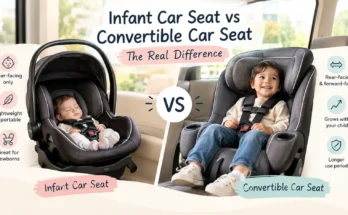
You May Also Check: Infant Car Seat vs Convertible Car Seat: The Real Difference
10. Replace the Seat After a Moderate or Severe Crash
A car seat can sustain damage during a crash, even when there is no visible damage. After a moderate or severe crash, replace the seat rather than continuing to use it.
Check your seat manufacturer’s instructions for its specific crash-replacement guidance.
11. Twisted Straps And Wrong Belt Paths
Here’s a situation I’m sure most of us have been in at some point. You are unbuckling your baby from their seat when you notice that one of the straps is twisted.
A twisted strap can affect how crash forces are distributed across your child’s body.
It’s easy to overlook a twisted strap in the busyness of everyday life. Run your fingers along the length of each strap, from top to bottom.
If you find a twist, fold the strap at the buckle or anchor point and slide the twist out until the strap lies flat.
The same courtesy should be given to the belt path of the seat. It should always follow the correct path as outlined by the seat. Most seats will have a coloured guideline.
Rear-facing and forward-facing belts will have different paths, so bear that in mind when changing your seat around.
12. Using Two Systems At The Same Time
A lot of cars have built-in safety systems to hold your seat in place. These may be called ISOFIX or LATCH, among other things. Some cars only have the seat belt system. It is advised to use only one system or the other, unless stated otherwise by the manual for your seat.
When installing with a seat belt, make sure the belt is locked according to your vehicle and car seat instructions. An unlocked belt can allow the seat to move more than it should.
Anchors have weight recommendations as well. As your baby grows, you may need to transition from an anchoring system to the seat belt. Your manual will give you specific numbers for your vehicle and seat.
13. Choosing The Wrong Spot In The Car
The back seat is the safest place for your little one. A rear-facing seat must never be placed in front of an active front airbag.
Airbags deploy with a lot of force, enough to potentially cause injury to a child. Front seats should only be used if there is no other option and the airbag can be turned off. The center rear seat can be a good position only if the seat can be installed tightly and correctly there.
Check your car seat and vehicle manuals before allowing the car seat to touch the front seat. Some seats allow contact, while others require a specific amount of space.
If you are driving a vehicle with no back seat, consult your car manual before attempting any seat installations. Some vehicles do have the capability to turn off the airbag from the driver’s seat.
14. Letting Your Baby Sleep In The Seat Outside The Car
Let’s talk about a relatable scenario. You pull up to your house and notice your baby has fallen asleep in their seat. You really don’t want to wake them, so you decide to leave them be for now.
What you may not realize is that a car seat is not a safe sleeping environment for your child. When a baby sleeps in a forward-facing or rear-facing seat on a flat surface, their head can flop forward and obstruct their airway. This can cause suffocation, especially in newborns.
Move your sleeping baby onto a safe, flat, firm surface as soon as possible. Do not leave a baby or toddler in a car seat on a bed, sofa, or high table.
If you use an infant carrier, follow the manufacturer’s instructions for the handle position while driving. Never place an infant carrier on a shopping cart or another high surface where it could fall.
On longer journeys, avoid keeping your baby in the seat for extended stretches without a break. Regular breaks allow you to take your baby out of the seat and help reduce positional risks.
Simple Habits Worth Building Into Your Everyday Life
- Knowing what to do is one thing, but how will you put it into practice every day? Habits are what get us through the motions, and Creating simple routines can also make everyday life easier, especially during the newborn stage. Here are some practical time management tips for new moms.
- Try out a pre-drive ritual. Make sure the seat is not loose, the straps are not twisted, and the harness is snug. Slide the chest clip up to the right height. Make it part of your everyday life. Some people say the words out loud, and it’s not a bad idea.
- After securing your child, take a look around the car. Heavy water bottles or hard toys can become deadly projectiles in the case of an accident. Keep heavy items in the boot or on the floor of the car. Keep hard objects out of the reach of your child.
- It’s also important to educate other carers who interact with your child on a regular basis. Grandparents, nannies, and friends should all know your safety routines.
- Show them how to do the pinch test and how to move the chest clip up to the right position. A few minutes of practice can help everyone who cares for your child follow the same safety routine.
- Finally, think about times when you are not driving your own car. Take a taxi or a ride share if you’re in an area that permits it. Bring your seat along with you wherever you go.
- Practicing an installation with a seat belt before you need it is a much better alternative than fumbling in the dark when you really need it.
Quick Checklist
Habits work best when you can see them at a glance. Here is a short list to run through before every drive.
The seat moves less than an inch at the belt path.
The recline angle matches the level line or bubble.
Your baby faces the rear and is within the seat’s height and weight limits.
The harness passes the pinch test at the collarbone.
The straps sit at or just below the shoulders, and none are twisted.
The chest clip sits at armpit level.
There is no bulky coat under the harness. Use a blanket on top instead.
Only products that came with the seat are in use.
The seat is not expired, recalled, or missing any parts.
The seat is in the back, never in front of an active airbag.
You use the belt or the anchors, not both, unless the manual says so.
Nothing heavy or hard is loose in the car.
At home, your baby moves to a flat, firm sleep surface.
Your baby is never left alone in a parked car.
Where To Seek Help If You’re Uncertain
Even after all of this, you may still be a little unsure. The feeling is completely normal, and rest assured that a trained pair of eyes can give you the confidence to be certain of your own skills.
Many hospitals, health departments, and family centres have trained professionals who can guide you through a car seat installation. Mayo Clinic Health System recommends calling ahead to find out if this service is available in your area.
Bring your seat, your manual, and your car so that they can guide you through the process. Ask them to observe as you install the seat, rather than doing it for you. That way, you’ll have first-hand knowledge of what to do next time.
If this option isn’t available where you live, call your seat manufacturer and ask for their recommendations. Many offer online guides which break down exactly how to install your specific seat.
FAQs
How tight should a harness be?
You should be able to feel the harness snugly hugging your baby. Try to pinch the material at the point where the harness meets the collarbone.
If you can pinch a fold of the material, it means the harness is too loose. If the material slides off your fingers, it’s a good fit. You should repeat this test every time you buckle your child in the seat, as thin and thick clothing can impact the reading.
When should a baby be turned to face forwards?
You should keep your baby in a rear-facing seat for as long as they are within the seat’s height and weight recommendations. These will be stated on the seat itself and in your manual. If your infant seat is outgrown, a larger rear-facing seat is a good option. You should also check your own country’s regulations, as they differ.
Is it safe to use a second-hand infant seat?
It can be, as long as you know the history of the seat. Make sure it has not been in an accident, and that the expiry date has not passed. All the necessary parts should be there, and the manual should be included with the seat. If you are unsure about any of these factors, a new seat is a safer option.
Can a baby sleep in a car seat once the car has stopped?
It is not recommended to let a baby sleep in a car seat outside of the car. Car seats are designed to keep your child safe and secure on the road. On a flat surface, a baby’s head can flop forward and obstruct their airway, causing suffocation. Never leave a baby or toddler sleeping in a car seat on a bed, sofa, or high table.
Is it okay to put a baby in a car seat wearing a thick jacket?
It’s best to avoid thick jackets and winter coats whenever possible. In the case of an accident, the puffy material will flatten and create a loop of slack between the harness and your child’s body. Dress your child in warm, thin layers instead. You can also tuck a blanket over the harness for extra warmth.
How do I know if my car seat is installed correctly?
You can start by doing a one-inch test. Hold the seat at the belt path and give it a firm tug from side to side. It should move no more than an inch. If you’re still unsure, seek out a trained professional. Many health facilities offer this service, so give them a call to see if it’s available in your area.
One Last Thing Before You Buckle Up
Do you remember the beginning of this article? You, reading about car seats like you’re studying for an exam. That shows me a huge amount of love, and I appreciate it deeply. You will not always be perfect, or on time, or prepared.
That’s part of being human and being a parent. Some days will be good, some days will be messy. But I know you’ll find a few little routines that will make your next drive a little bit safer for the most important person in your life.
So here’s to tonight, or tomorrow, or the next time you get into your car. Tug at the seat, pinch the harness, and slide that chest clip up to the right height. It’ll only take two minutes, and it’s a habit that will keep your family safe for the rest of your lives together.