
Somewhere between the last video conference before your maternity leave and the first one after it, a tiny human learned to smile, roll their belly, and laugh uncontrollably at your silly face.
And so begins the maternity leave math. A few months and a lifetime pass, and now the inbox is reminding you to return to work.
Nobody told you that returning to work is technically two transitions: one internal and one external.
One is learning to pull away emotionally from your baby with each step out the door. The other is learning to reconfigure your world so that your morning routine and closet are prepared for your return.
You are allowed to feel both, and you are even allowed to feel proud and heartbroken at the same time.
Here’s the real secret to returning to work prepared: your first two weeks back may feel messy. You might forget something, run late, rethink your entire morning routine, or feel emotional when you leave your baby.
That’s normal. You’re not failing—you’re adjusting to a completely new routine. This article is your guide to making those two weeks and all that comes after feel like a system, not like a test you’re likely to fail.
Two Weeks Before Returning to Work After Maternity Leave: Your Prep Plan
The night before your return isn’t enough time to prepare yourself, your baby, and your household for the transition. Two weeks out is your countdown clock, and you should pace yourself instead of cramming your prep tasks into an anxious, rushed weekend.
14 Days Out: Start the Childcare Trial
If your baby is going to daycare, stay with a babysitter, or spend time with grandparents, start with short trial periods.
Try an hour or two at first, then gradually increase the time. This gives your baby a chance to adjust and gives you a chance to see what works before your first day back.
10 Days Out: Practice the Feeding Routine
If your baby will be taking bottles while you’re at work, start practicing now rather than leaving it until the night before.
If possible, have another caregiver offer some of the bottles so your baby gets used to feeding without you.
7 Days Out: Do a Full Morning Dry Run
Wake up at the time you’ll need to on a workday and follow the entire routine: feeding, getting yourself ready, dressing the baby, packing bags, and leaving the house. Note where you run out of time and add a realistic buffer.
5 Days Out: Prepare Your Work and Baby Bags
Keep the things you’ll need regularly in one place. Depending on your routine, that might include your work bag, diaper bag, pump and accessories, bottles, snacks, or a change of clothes. Preparing these ahead of time means fewer decisions on busy mornings.
3 Days Out: Check Your Work Clothes
Try on a few outfits before your first day back. Your body may have changed since pregnancy, so don’t wait until the morning of your return to discover that your old work clothes aren’t comfortable. Pick two or three outfits that make you feel comfortable and confident.
1 Day Out: Keep the Evening Simple
Lay out your clothes, prepare the bags, check your schedule, and make sure you know who is handling childcare the next morning.
Don’t try to reorganize your entire life the night before. The goal is to make the first morning easier, not perfect.
Talking to Your Employer About Your Return
A short conversation with your manager before you return can make the transition much easier. Ask whether your company offers a phased return, flexible start times, or work-from-home days.
Be specific about what would help you manage the transition, such as starting slightly later for the first few weeks or working from home on certain days.
If your employer has a formal policy for returning from maternity or parental leave, ask for the details in writing.
Knowing the expectations ahead of time gives you one less thing to figure out during those first busy weeks.
You May Also Like: Moving with Kids While Working: How to Survive the Chaos Without Losing Your Job or Your Mind
The New Morning Routine: Creating a System for Returning to Work
Morning routines are the heart and soul of the transition back to work, and a good system is worth its weight in gold.
You will learn to create what’s known in project management as a buffer: extra time built into your morning to give you breathing room in case something goes wrong.
This is critical to a smooth morning. Complete whatever you can the night before, such as preparing bottles, snacks, bags, and clothes. So you don’t have to fumble with them in the morning.
You should build in extra time to your morning schedule to account for the fact that no matter how well you plan, it can all be undone by a late diaper change or a sudden meltdown.
And finally, you should have a backup plan for your morning in case of disaster.
Splitting the Load: Getting Your Partner Involved
None of this will work if you are the only one doing it, so be sure to enlist your partner to help as well.
Split your tasks and responsibilities so that you’re both sharing the workload instead of shouldering it all on your own.
You and your partner should talk through what needs to be done before your return date and agree on who is doing which tasks. It’s good to have a physical reminder of this, too, so writing it down in a shared notes app could be good enough for now.
A simple way to make the transition easier is to divide household and childcare responsibilities clearly with your partner.
By doing this, you remove the resentment that can crop up when one partner assumes the other ought to know what’s what without ever discussing it.
Pumping and Feeding Logistics: Returning to Work While Breastfeeding
There are a lot of logistics involved in working while breastfeeding that should be ironed out ahead of your return date. First, you should talk to your Human Resources representative to confirm where you can pump at work. Ask your HR representative what private space and break arrangements are available for pumping at your workplace, and check the policies or protections that apply to you.
Make sure to have a pumping schedule worked out that matches your baby’s feeding schedule as closely as possible while still accommodating your workday, and you should set phone reminders so you don’t forget to pump throughout the day.
You should also bring extra supplies to work (bottles, bags, etc.), extra pump parts (because you never know when one might break), and a cooler bag for storing milk if your employer allows you to store it at work.
If you want to know how long breastmilk can be stored at various temperatures, you should bookmark or print out this page from the Mayo Clinic that explains in detail how long breastmilk can be stored at different temperatures.
Save a reliable breast milk storage guide on your phone or keep a printed copy in your pump bag for quick reference.
The Emotions of Returning to Work: Managing Guilt and Anxiety After Maternity Leave
No one tells us how loudly our guilt can speak up for us while we’re away from our children. You may feel guilty while you’re in a work meeting; your brain may convince you that your baby is crying for you this very second. It may feel guilty on your best days at work, finding yourself unexpectedly enjoying your coffee in the morning without your child and berating yourself for those feelings.
You can think about work at all when you’re home with your baby or for not thinking about work often enough when you’re at the office.
But the truth is that these are all normal, expected emotions to experience while you’re away from your child.
You may feel guilty when you leave your baby for work, even when you know you’re making the right choice for your family.
What you should NOT do is feel guilty about feeling guilty.
Give yourself space to acknowledge the feeling without shame, and remind yourself that your baby is in good hands while you’re at work.
You should be kind to yourself and permit yourself to love your work just as much as you love your baby, and let go of the idea that the two things should be mutually exclusive.
If your anxiety feels too heavy and pervasive to ignore, you should talk to your doctor instead of suffering in silence, especially since there are treatment options for postpartum anxiety.
For a deeper understanding of postpartum anxiety, you should read this Cleveland Clinic guide to postpartum depression and anxiety.
Whereas for an understanding of how to engage in daily rituals of self-care when you have those feelings, you should read our Self Love category articles about developing a healthier relationship with yourself after having a baby.
Back To Work in India: The Differences to Note Beforehand
If you are going back to work in India, we have put together some key differences that you should be aware of.
Under the Maternity Benefit Act, 1961, as amended in 2017, eligible women covered by the Act may be entitled to up to 26 weeks of paid maternity benefit for the first two surviving children, subject to the conditions and eligibility requirements under the law. For women with two or more surviving children, the statutory maternity benefit is generally 12 weeks.
The law also includes provisions relating to nursing breaks and crèche facilities in establishments covered by the relevant requirements. Establishments with 50 or more employees are required to provide a crèche facility as prescribed under the Act.
Depending on the nature of the work, the Act also provides for the possibility of working from home after maternity leave, where the employer and employee mutually agree on the period and conditions. This does not mean that every employer must automatically provide a work-from-home arrangement.
Before returning, check your company’s maternity and parental-leave policies and speak with HR or your manager about your expected return date, working hours, childcare arrangements, nursing or pumping needs, and any flexible-work options available to you.
Because maternity benefits can depend on the law, your employment situation, and your employer’s policies, consider checking the latest government guidance or obtaining professional legal advice if you have questions about your specific rights.
First Day Survival Kit
Your first day back at work doesn’t have to be perfect. A little preparation can make the morning—and the rest of the day—feel much easier.
Before You Leave Home
- Charge your phone the night before
- Pack your work bag and baby bag in advance
- Keep your baby’s essentials, including diapers, wipes, feeding supplies, and a change of clothes, ready
- Pack a spare outfit for yourself in case of spills or unexpected messes
- Save your caregiver’s number and keep it easily accessible
For Your Workday
- Carry a water bottle and a few easy snacks
- Pack pumping supplies if you are breastfeeding
- Keep your schedule as simple as possible for the first day
- Permit yourself to check in with your baby without feeling like you need to be constantly available
Before You Go Home
- Check whether you need to take home any bottles, pump parts, or baby supplies
- Confirm the next day’s childcare arrangements
- Take a moment to acknowledge that you made it through your first day back
Remember: The goal of your first day is not to prove that you can do everything perfectly. It’s simply to get through the day, learn what works, and make the next morning a little easier.
Free Printables for Returning to Work
Want to make your return to work a little easier? We’ve created a simple 2-page printable to help you prepare.
It includes a two-week return-to-work countdown, a morning routine checklist, and a first-day survival kit—so you can organize the essentials without trying to remember everything at once.
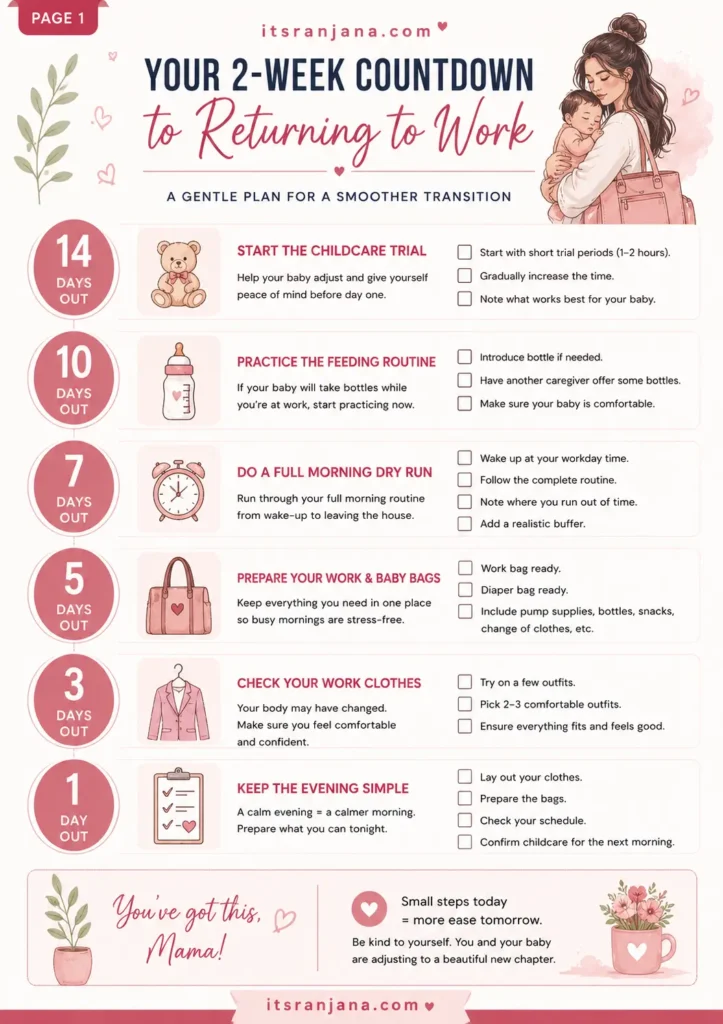
And keep it somewhere you’ll see it during the days leading up to your return.
Your Final Thoughts
You are not choosing between your baby and your career. You are choosing between two wonderful parts of your life that both deserve your love and attention, and you’re learning to manage that balance, which is not an easy task.
Some mornings you’re going to flow effortlessly, and some mornings everything is going to be a disaster before you ever leave the house, but remember that both are valid parts of your transition.
You deserve to be comfortable in your skin as a mother, employee, and independent agent.
FAQs
How long does it take to adjust after going back to work from maternity leave?
There is no fixed timeline for adjusting after maternity leave. For some people, the first few days or weeks are the hardest; for others, it can take longer.
The first few days or weeks will still be the most challenging as you get used to your new normal.
If after a month you’re still struggling, you might consider discussing further flexibility with your manager, depending on your circumstances. You can talk to your doctor about postpartum anxiety if you suspect it to be the reason.
How do I deal with guilt about leaving my baby for work?
The best way to deal with guilt is to acknowledge it, as guilt is often louder when it’s not registered as such.
You should remind yourself that your baby is being taken care of by trustworthy people and your partner while you’re at work. You should grant yourself permission to enjoy your own time while you’re away from your child.
Another good way to manage it is to create a little ritual with your baby that involves saying goodbye and a hug, so you’re both aware of it as something special, and you can part ways without a second thought. Usually, guilt fades away as time passes, but it’s there for a reason, so don’t ignore it.
What is a good pumping schedule for work?
A good pumping schedule should reflect your baby’s feeding schedule as much as possible within your work hours.
Some people find it helpful to pump every few hours during the workday, depending on their baby’s feeding pattern, milk removal needs, work schedule, and individual circumstances.
Make sure to set phone reminders for pumping sessions because it can be easy to forget them when you’re busy with work.
Why do new moms feel so tired during the first year?
According to research on new moms, most women sleep significantly less in the first year after childbirth, frequently in shorter cycles than they did before pregnancy.
It can get better as your child gets older and their sleeping patterns stabilise, but everybody has different schedules, so it’s hard to define what the average amount of sleep looks like for new moms.
If you’re feeling tired and sleepy all the time and it’s affecting your ability to function in day-to-day life, it’s important to discuss it with your doctor, as there are treatments for sleep deprivation, especially for new moms.
How do I ask my employer for a flexible return to work schedule?
You should talk to your employer about a flexible return to work schedule sometime before your intended return date (preferably several weeks in advance).
You should ask them about any phased return options your company offers, as most places allow you to gradually return to your full-time schedule over a span of two weeks, depending on your circumstances.
Flexibility could also mean working from home on certain days before you return to the office, so you should ask about that as well before your return date.
It’s important to ask for specific things you want help with rather than a vague promise of flexibility, as most employers prefer clear directives to vague ideas when it comes to returning to work.
What should I pack in my work bag as a new mom?
As a new mom, you should pack your pump and its accessories if you’re breastfeeding. You should bring a cooler bag for your milk if your employer allows you to store it at work.
You should also bring a spare set of clothes for yourself in case of an emergency, along with healthy snacks and a large water bottle to keep you satiated throughout the day.
Most importantly, you should always carry a small pouch with your baby essentials in it (nursing pads, hand sanitiser, etc.) and your caregiver’s number so you can contact them easily if anything goes wrong.