
It’s 8:45 on Monday morning. In 15 minutes, your first work call will arrive, breakfast is still on the table, one child can’t find their school shoes, and another one wants the toy that you packed last night.
Boxes are in the hallway, tape is on the kitchen counter, and your phone is reminding you that you haven’t yet confirmed movers.
You have not even opened your laptop!
Moving with kids is already stressful. Add a full-time job, and keeping everything under control can feel overwhelming.
For a working mom, the challenge isn’t just packing boxes—it’s keeping work, childcare, meals, routines, and deadlines moving at the same time.
You’re replying to emails, dealing with deadlines, taking care of your kids, cooking, packing, and trying to maintain a normal routine for your family.
Why the Usual Moving Advice Isn’t Enough
The general rule for moving is to label all boxes, move a little bit every day, and get started early. While those tips will work, they don’t take into account the largest issue for many working moms: the time to actually do it all.
You get an hour to yourself after you’ve finished work, dinner, homework, baths and bedtime. Three hours packing the kitchen cupboards each night sounds like a worthwhile task on a checklist, but that’s not necessarily the case in reality.
That’s why moving with kids while working requires a time-based strategy, not just a packing checklist.
You’ll learn what to deal with right away, what you can wait to deal with, what to take with you on moving day, and how to balance your work and family responsibilities during the days that you have both.
Moving with kids can be different when you have a full-time job
For almost all of us, moving is already stressful, but when you’re moving with children and a full-time career, you’ve got a lot to do. You don’t stop having to do your chores if there are boxes in all your rooms.
It may be Saturday morning, and you’re thinking about packing the bedroom. Then there’s breakfast to be prepared, homework to be done, laundry to be done, and lunch is far sooner than anticipated.
By afternoon, you may have packed just one shelf and somehow made the room look worse.
The other problem on Monday will be: work starts again. Meetings, emails, deadlines, school runs, meals and bedtime remain the same.
The Mental Strain of Packing Is Often the Hardest Part
A lot of the stress from moving comes from the number of small details you have to remember. Have you checked with the movers? When to change the address? What documents does your school need?
Who’s going to take care of your children? Do you need to take PTO? Can you pack the coffee maker now, or will you need it tomorrow morning?
All these decisions aren’t big ones, but they are cumulative. Keeping track of small decisions throughout the day can be exhausting, and even more so at night, when you’re in bed with your baby.
Constant Interruptions Make Small Jobs Take Longer
When kids are present, a 30-minute task can easily take an hour! You begin filling a cupboard, pause to make a snack, pick up the cupboard again, answer a work call, and realize that your child has removed the marker you were marking the boxes with.
This is particularly true if you are moving with a toddler and working: your toddlers need frequent attention, and they don’t understand why you suddenly need an uninterrupted hour.
You Need a Time-Based Plan, Not Just a Packing List
The packing checklist tells you what you need to pack. It doesn’t provide the solution to the question of when a working mom should do it.
Instead, it is better to assign different tasks to the various stages of the move. Eight weeks before a move, you make big decisions. Four weeks before the move, start packing items you don’t use very often.
Two weeks ahead, you prepare the necessary items. By this point, most of the difficult planning should already be done.
This way, it seems like a series of smaller assignments rather than a big project looming over your head all day long.
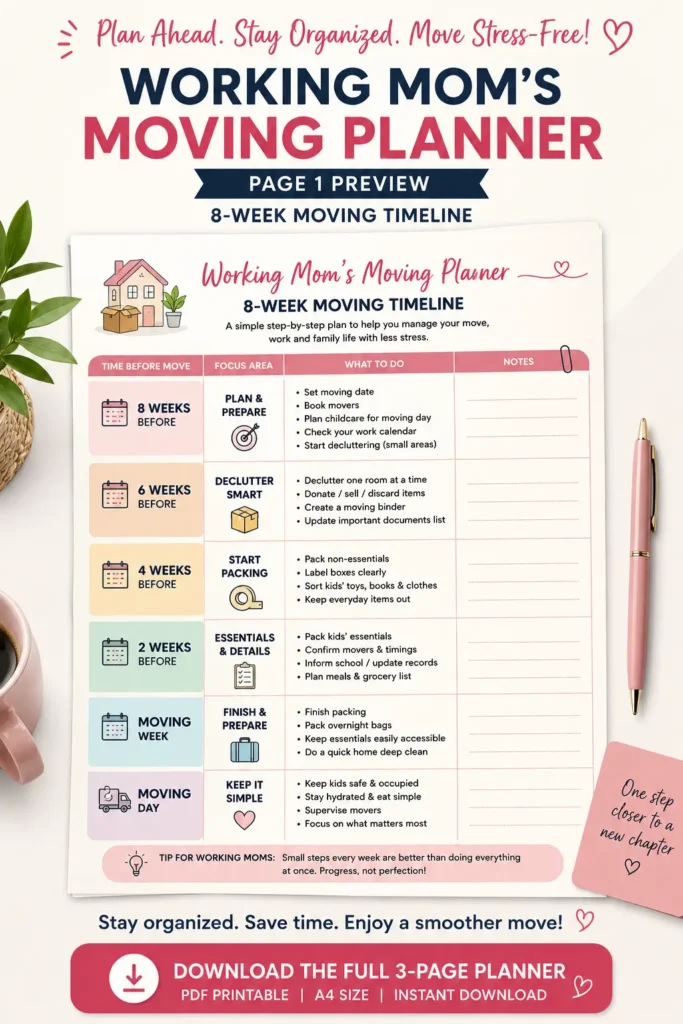
Working Mom’s Moving Timeline at a Glance
| Time Before Move | Main Focus | What To do |
| 8 weeks before | Planning | Set date, book movers, plan childcare |
| 4 weeks before | Start Packing | Declutter and pack non-essentials |
| 2 weeks before | Essentials | Prepare essentials and confirm plans |
| Moving week | Finish and Prepare | Finish packing and pack overnight bags |
| Moving day | Keep it simple | Focus on safety, kids and essentials |
Not all dates need to be followed in exact order. If you are short on time, skip some stages and concentrate first on those most likely to cause you trouble if you miss them.
8 Weeks Before the Move: Sort out the big decisions
First, choose the date you are moving and then go to your work calendar. Notice what is going on the week prior to and following the move.
This is also an ideal opportunity to determine if you will need time off from work. Make sure to review your PTO balance and your company’s policy on leave requests.
If the move is expected to affect your work routine, begin planning when to have a conversation with your manager.
Confirm Movers Before Your Calendar Gets Busy
After you’ve scheduled a date, arrange for the moving truck or moving van. Don’t wait until moving week to take it for granted that someone will be available at the time you need.
If you are going to let someone else look after your kids on moving day, make the arrangements now! A grandparent, relative, friend, babysitter, or other trusted adult might be able to keep your kids out of the busiest portion of the move.
Start Decluttering without Giving up your Weekend
Decluttering doesn’t have to take 6 hours on Saturday. Small sessions are more manageable in the working and family environment. Empty a drawer while you’re cooking dinner, clear out a shelf before going to bed, or spend 20 minutes sorting through old clothes.
Each item you will remove will save you three jobs later: packing, moving, and unpacking.
Create a Family Moving Calendar
Keep all moving dates, work deadlines, childcare, appointments, and other important dates in one place. Use your phone, writing paper, or a simple moving planner printable.
It is not about the planner being perfect. You just want to view your work, your family, and your moving plans side by side so nothing important is missed between them.
Moving with kids while working can feel overwhelming. To make it easier, I created a simple 3-page printable planner you can download and use before, during, and after your move.
4 Weeks Before the Move: Start packing the things you rarely use
Four weeks before moving day, begin packing items which the family is unlikely to use over the next month. Books, decorations, extra bedding, seasonal clothing, and seldom-used kitchen items are good places to start.
Don’t pack everyday items too early. Right now, if you put away all your kids’ favorite toys, then there’s a high probability that you’ll be opening those boxes again 3 days later.
Use short evenings and weekend packing sessions
Packing can be easier for working moms when it’s broken into shorter sessions instead of one long day. Try packing for half an hour once or twice during the week and setting aside one longer session on the weekend.
Have a clear objective for each session. Take Tuesday to the bookshelf. Thursday could be one wardrobe. Saturday may be the cupboard that stores things. It’s easier to begin a small job, and you can see yourself completing it.
Begin to tidy up children’s belongings
Have your kids identify a toy, book, clothing, or comfort object that they wish to have available to them until moving day. Your younger kids can help with such tasks as putting stickers on boxes, and your older children can pack some of their own items.
It’s also a great time to make changes to your school or childcare plan if you are moving. Handle forms, records, dates, and other things now rather than in the last week.
2 Weeks Before the Move: Safeguard what remains important to your family
By now, your home will probably look like you’re moving. Boxes can be piled against walls, some cupboards are empty, and you might occasionally lose an item of your belongings.
Most things you don’t need can now be packed, but items you use every day require another strategy. Medicines, chargers, work equipment, school supplies, important papers, and clothes for the next 2 weeks should be easily accessible.
Prepare the kids’ essentials
Begin packing items your children will need while moving and once they have moved in. These can be clothes, school supplies, hygiene products, and comfort products.
Avoid filling their box with all of their favorite items just because they fit in. Your child’s favorite teddy bear or blanket may be far more comforting in the car than packed inside the moving truck.
Make Food One Less Thing to Think About
Use up food already in the freezer and don’t go out and stock more food that you will need to carry. Make meals simple in the last two weeks and determine which evenings it is OK to order food.
After a full day of work, parenting, and packing, the last thing you need is another complicated dinner decision.
Reconfirm school and childcare arrangements before moving week
Review the moving company booking and verify the date, time, and any other crucial details. Repeat with your kids’ helper(s).
Plans made several weeks ago may have changed, so a quick confirmation can prevent last-minute problems!
Create an alternate work plan
Consider the workload and what would occur if issues relating to moving took longer than anticipated. Where possible, complete important work in advance and ensure that there is someone who knows about anything that urgently may require attention.
It is not necessary to anticipate any issues. You just don’t want your only plan to be based on everything going as smoothly as it can.
You May Also Like: Returning to Work After Maternity Leave: A Realistic Guide for Working Moms
Moving Week: Make Life Easier, NOT Perfect
Moving week is the time when routines begin to vanish. Meals may be simpler, some clothes may be unpacked, and you may have to walk around boxes just to reach the sofa.
You’ll only be putting pressure on yourself if you try to get everything in your home, career, parenting, and moving on track at the same time. This week is to be a week of completion and a week to make moving day easier.
Keep your workload to a minimum wherever possible
If it’s in your control, don’t schedule extra meetings or bulky new projects at the end of the moving week. Do important work before the end of the day and inform your team of when you won’t be available.
Even if you have a lot more work to do, you can still drop some optional commitments so balancing your full-time job with the move will be easier.
Conclude Packing Without Packing Your Daily Life
Complete the remaining boxes, but divide up items that will be used in the last few days. Items like your phone charger, medicines, work tools, toiletries, children’s bedtime items, and some basic kitchen supplies should still be easily accessible.
This is also the time to create each person’s moving day bag and main moving day items.
Make an overnight bag for all
Pack a separate overnight bag for each family member. Pack it as if you would stay somewhere for one and/or two nights. Pack clothes, toiletries, medicines, chargers, and anything else your kids may need for bedtime.
When you get to the new house tired after 40 boxes, you’re glad that the pajamas and toothbrushes are not in box #27.
On Moving Day: Keep the Goal Simple
Moving day can get hectic in no time at all. The doors are open, the boxes are being carried out, the furniture is in the hallways, and your kids might be excited, bored, and hungry.
You don’t need to unpack everything or make sure every box reaches the perfect room. Keep safety, food, and your essentials at the top of your priorities list and try to keep your kids’ schedule just as normal as possible.
Avoid letting children go to the busiest places
If there is child care available, then moving day is a good time to utilize it. Children will not wander around near heavy furniture, open doors, or people carrying boxes if they have a trusted adult to watch them for some time.
If the children remain with you, provide a safe place for them, separate from the path of movement. Have snack and beverage options available and activities close by so you do not have to look around and search for them in bags all of the time.
Carry Your Work Items With You
Make sure your laptop, charger, phone, headphones, and necessary work papers are always with you. If you will need to work later in the day or the next morning, keep them with you instead of burying them deep inside the moving truck.
Do the same with medicines, important documents, keys, and anything else difficult to replace.
Put Safety Before Routine and Productivity
How many emails you responded to, or boxes you unpacked during the move, isn’t the best way to judge yourself. Make sure everyone is fed, hydrated, has access to essential supplies, and reaches the new home safely.
You can move on to work and unpacking later. It’s better to have a more relaxed first night than to do too much.
How to talk to your Employer about a move
One of the biggest concerns while relocating with a full-time job is what to disclose to your employer. You might need a day off, a different schedule, or a little flexibility around the move.
When you’re considering telling your boss you’re moving, remember to keep the focus on the job. Your manager doesn’t have to know everything about your packing issues and plans for your kids.
Tell your manager early when possible
After finding out when your move is, and after reviewing your work calendar, determine when your manager needs to be informed. In the event you need PTO or the move could impact a significant deadline, the earlier the notice, the greater time that everyone has to prepare.
When a presentation, project deadline, travel to work, or a meeting with clients is important, it’s better to find out sooner so you can plan accordingly.
Describe why, due to attendance, there may be a change in your availability and what you are doing to ensure important work is covered.
Be Clear About PTO
If you need to take some time off for a moving day, make that known explicitly, not just saying that it will be a challenging week. Review company leave policies and apply for leave as per standard procedure.
If not a full day, you might be able to request a few hours.
Ask About Temporary Flexibility
Depending on your role, you may be able to adjust your working hours, work from home, or use a temporary hybrid schedule.
But, for instance, the morning after the move, when you’re working from home, is easier than when you’re going to work with half your clothes in boxes.
Prepare for Work Conflicts in advance of Moving Day
Don’t wait and hope everything will work out if the moving day approaches a big meeting or deadline. Discuss with the manager, complete as early as possible, or make back-up arrangements if possible.
If you are moving for a new role while managing childcare, for example, talk about when you’ll be able to work somewhere reliable, your temporary living situation, and when you’ll be home.
Maintain a professional tone in conversation
It’s okay to express your need for flexibility without revealing all your personal information. Let your manager know what they need to know, explain what you are asking for, and explain how you will do your job.
This makes the dialogue easy for both of you.
How to Keep Kids Busy While You Work During Moving Days
At times you might need 20 quiet minutes to complete an email correspondence or half an hour for an important call. Simply expecting your kids to keep themselves busy while you work usually doesn’t work.
Instead, prepare a few activities before you sit down to work. This will vary depending on your child’s age.
Toddlers: Be Prepared with a Simple Activity Basket
Working with your toddler may be particularly challenging when moving, since toddlers typically require lots of attention. Have a small basket of safe activities including sticker books, coloring pages, simple puzzles, blocks, or favorite toys.
Give them something little at a time. Save one or two activities for the times when you really need to focus.
Screen time can also be helpful on an especially hectic day. Moving week passes and an extra episode of a show your kids are fond of may provide enough time to complete an important project.
Preschoolers: Make Packing Fun!
Your preschooler can help with small moving jobs. Place coloured stickers on their boxes and let them sort a few things in their bedroom.
The box doesn’t need to be packed perfectly—the goal is simply to keep your child involved and make the move feel less overwhelming.
Get School-Age Kids Real Jobs
Your older kids can pack books, sort toys, make their own bag, or choose what they would like to have out on the first night.
They may also be able to read, complete homework, use educational activities, or have some scheduled tablet time when they have work to do.
It’s usually better to give clear instructions than just, “Keep yourself busy while I work.”
When you have an important work call
Before the call, tell your children about the call. Plan for a designated quiet time activity, have some snacks and drinks ready, and make sure they know how long your activity will take.
In particularly important meetings, if there is another adult available, have them take over. If this isn’t an option you have, try to prepare as much as you can and know that it may not be a traditional workday.
The aim is not to achieve perfect productivity. It is enough to get the important work done without putting the children at risk and keeping them entertained.
The Working Mom’s Moving Day Survival Kit Table at a Glance
| Category | What to pack |
| Work essentials | Laptop, charger, phone, headphones, power bank, important papers |
| Kids essentials | Clothes, snacks, water, school supplies, favorite toy |
| Baby essentials | Diapers, wipes, bottles, extra clothes |
| First-night essentials | Pajamas, medicines, bedding, towels, toilet papers |
| Next-morning essentials | Breakfast basics, tea/coffee and everyday kitchen items |
Don’t expect kids to adjust immediately
You’re aware of the plan and what’s coming. Your child may see the same move very differently.
Your children’s bedrooms are being packed up, familiar belongings are disappearing into boxes, and they may be leaving behind friends, school, or a neighborhood they know.
Let your child know what’s going on and give them time to adjust.
Be Honest about the move
Talk about the move in an age-appropriate manner. Explain where you are going, approximate departure time, and what will happen to their possessions.
Show pictures of the new home if available. Describe your children’s new room or the local areas they might want to visit, and acknowledge questions they might have about what they are concerned about.
Allow Them to Participate In Small Decisions
While your kids are not expected to select the trucking firm or the moving date, they can make some smaller choices.
Have your children decide on which toys will fit in their own bag, what object will be in their own bag, or where a favorite will be placed in the new room.
Some small things can make them feel a part of the move rather than a part of a move happening to them.
Maintain Familiar Routines Wherever Possible
Moving week will not be exactly as usual, but attempt to maintain some of the routines that are familiar. Your child’s favorite story, breakfast, or blanket can offer some comfort.
There’s no need to safeguard all routines. Choose those that are most important to your child.
Give Them Something Familiar From the Old Home
Avoid stuffing all the familiar items in the moving truck. Bring a favorite toy, pillow, blanket, family picture, or other small comfort item with your child.
Having a familiar item in the new bedroom can help the first few nights be a little easier.
Give Them Time to Say Goodbye
Don’t forget to say goodbye to friends, school, family members, or a favorite neighborhood if the move requires it. Your children may want to go to their favourite park, take pictures of their old room, or see friends before they go.
Although they may not make moving easier for kids at the moment, these moments provide an opportunity for your kids to know that a part of life is changing.
For some kids, the excitement doesn’t last long, and the first day at the new home could be the last. Some may miss their bed or their old friends and require some more time.
Don’t measure the success of the move by the expression on people’s faces on the first night. Settling in can take a little time when there are multiple changes to a child’s routine at the same time.
Working with Your Partner during the Move – Splitting the Load
Tell me what you need help with” may sound helpful, but it can still leave one person responsible for remembering, organizing, and assigning every task.
The better solution is to share out the responsibilities prior to the week of movement. Assign each component of the move to either one person or another.
Instead of Random Tasks, divide responsibilities
One person may take care of the movers, moving dates, utilities, etc. The other can pack the kids’ moving day bags and take care of their food, childcare, school setup, etc.
This will vary from person to person according to working hours and family, and each individual should have an idea of which tasks they should be carrying out.
Use packing zones to divide packing
The same technique can be applied when packing. One person could be in charge of the living room and kitchen, while the other has charge of the bedrooms and storage areas.
This decreases the likelihood that both individuals will put their stuff in the same room, and a room will be left unoccupied.
Check In before Moving Week
Take a few minutes to go over the other jobs together before the week begins. Inspect the task that has been accomplished, what remains to be done, and if either person needs assistance with the task.
Just a short chat can avert the inevitable “But I thought you were doing that!” conflict on moving day.
A simple Moving Week Planner for Working Mom
A moving week planner should help you with your week instead of filling up all your spare time with another chore. The best plan is one that allows for time to work, raise kids, eat, and includes the extra curveballs that always pop up at the most inconvenient moments.
For instance, Monday may be a 30-minute packing time. Tuesday might be a time for a moving-related call or change of address.
Make Wednesday a free day unless it’s urgent. Pack up another small area on Thursday, review weekend priorities on Friday, pack a larger area on Saturday, and prepare meals, clothes, school supplies, and important work items on Sunday for the week!
Make Space for Real Life
Among the most important working mom moving tips is also one of the easiest to keep in mind: Don’t schedule every free hour.
A child could become ill, a job may be delayed, or a packing job may double in time. Some free time means that one setback won’t ruin an entire plan.
What can wait until after the move?
The first weekend in your new house doesn’t have to be completed without all boxes being ticked and all rooms being tidied. Begin with the items that will help your family to get back to “normal.”
Prioritize the things your family needs to get back to normal: beds, bathrooms, children’s everyday clothes, basic kitchen supplies, internet, and a functional workspace.
You don’t need pictures, decorations, perfectly organized cupboards, or elaborate storage systems right away.
It’s generally easier to slowly separate the boxes of material than to assemble a fully functioning house when everyone is exhausted.
FAQs
How do you manage moving with kids while working full-time?
Plan and break the move up into manageable chunks. Work out the details of moving, the PTO, the child care, and the school early, then have shorter packing times around the work schedule.
How to make a moving list for the working mom?
A useful moving checklist for a working mom should be organized around the time available before the move. Start by planning and decluttering, then pack non-essentials early and leave everyday items until the final days.
What are your suggestions for moving with a toddler when you’re working?
Have their favorite items in the house, set up brief independent tasks, and do not expect them to work for extended periods without breaks. If feasible, schedule childcare for the most hectic day of the move.
What are my options to work from home during the move?
Have one small workspace prepared until near the moving date. Keep laptop, power cord, headphones, and other work supplies in a group and establish a simple workspace first in the new residence.
What is the must-have list of items for kids’ moving day?
Bring clothes, personal items, snacks, water, school supplies, and a favorite comfort item. Diapers, wipes, bottles, and other basic care can be required for babies and toddlers.
How to pack a moving day survival kit?
Have your phone, chargers, paperwork, medications, work tools, clothes, toiletries, water, snacks, and your children’s immediate needs with you. Use a special first night box for bedding and essential household supplies.
Is a Moving planner printable useful for working mom?
If it provides a place for your work, moving, and family dates, it can be useful. Make it simple enough so it won’t become another chore instead of using it.
Conclusion
Moving with children can be challenging when you have to deal with three aspects of life – work, family and moving. While a large checklist is not necessarily the answer, a realistic timeline would make it easier to deal with this issue.
If you can, try to start the move early; break down tasks into smaller jobs; discuss the move with your employer before the last week; and have your moving- day essentials ready beforehand.
Find easy opportunities for your children to participate, have a clear division of tasks between you and your partner, and allow some flexibility in your plans to allow for the unexpected.