It’s 8:45 PM. Your child suddenly remembers tomorrow’s homework, their school bag is still unpacked, and you’re standing nearby repeating, “I told you to start earlier.”
Sound familiar?
Don’t worry. Your child may not be lazy. They may simply still be developing the skills needed to plan, prioritize, and manage time independently.
At ItsRanjana, I will share everything you need to know to teach your kids time management. Most importantly, all the things have been tried by me, both the mistakes and the good things, I did in this journey.
Let’s start with the importance of time management for kids.
Why Does Time Management Matter?
It doesn’t just help get good points, but it also teaches the skills they need for the whole life. When children learn to manage their time, they feel independent and don’t depend on parents for small tasks.
Right time management helps to build the habit of planning and organizing. They learn to balance homework, play, read, and rest. It helps to reduce rushing at the deadline.
Time management is a skill that makes your kids confident. Along with the conflicts between parents and children that generally develop over “Have you done your homework?”, “Do it ASAP”, and “We are getting late” become less frequent.
Kids learn to take responsibility and understand their needs, that help to develop responsibility-handling skills in them.
All these capabilities are related to executive function skills that include planning, concentration, self-control, and work management.
According to Harvard’s Center on the Developing Child, executive function skills help children plan, focus attention, remember instructions, manage multiple tasks, and make decisions. These skills develop over time and can be strengthened through practice and supportive experiences.
How to Teach Time Management Skills to Kids at Different Ages
One of the most important thing to know as a mother. Kids of different ages have different levels of understanding, habits, and necessity. Therefore, a single trick won’t work on all children. Below are some tips that help to develop time management skills in kids of different age groups.
3-5 Years: Making Habits of Routine and Transition
At this age, young children are still developing their understanding of clock time, so the focus should be on routines and transitions rather than exact timing.
- Use a visual timer so that the child can understand how much time is left to finish the task.
- Make a Picture Routine Chart in which some activities like waking up, brushing, and gathering the toys are mentioned.
- Use language like First… Then… e.g., “First collect the toys, and then we will read the story”.
- Give 2-step instructions to children, e.g., “First wear shoes, then bring the bag”.
- Practice the cleanup routine so that cleanliness develop in their habit.
6-8 Years: Understanding Time and Simple Planning
Children now understand the value of time. This is the best time to teach them small planning.
- Teach them to read the analog and Digital Clock.
- Make a Morning Checklist to prepare in the morning.
- Prepare a visual schedule for school, reading, and playing.
- Use the technique of “When this is done, then…” E.g.: ‘’When the homework is complete, then watch the T.V.”
- Give them a 10-minute Task Challenge so they can estimate the time and complete the work within that time range.
9-11 Years: Estimation and Planning
At this age, children can begin taking more responsibility for schoolwork and everyday tasks.
- Ask them: “What do you think, how much time will it take to complete this work?”
- Make a homework checklist for daily use.
- Teach them to plan the whole week through a weekly planner.
- Teach them to divide large homework and projects into small parts.
- Help them develop a habit of preparing school bags, uniforms, and other necessary things.
12+ Years: Prioritization and Independence
For teenagers, it’s necessary to set priorities and respect time. The goal is to gradually hand over responsibility rather than control every part of their schedule at this age.
Tell them about the A-B-C Priority Method:
A = Must Do Today
B = Should Do Soon
C= Can Wait
Along with this, teach them:
- Use of Digital Calendar and Reminder Apps.
- Note the deadlines of projects and assignments
- Balancing study and extracurricular activities
- Don’t say “Yes” to every work; they can say “No” also.
- Planning backward from deadlines so they will not get stressed.
You don’t need to be a manager at this age of your child; you should be a coach. Encourage them to create their schedule, plan, and take responsibility.
Practical Time Management Tools for Kids (Quick Table)
| Tool | Best For | How to use |
| Visual Timer | Young kids | Show them how much time is left to finish the task |
| Picture Schedule | Ages 3–7 | Show daily activities through pictures. |
| Checklist | Ages 6+ | Tell them to tick after completing their tasks. |
| Weekly Planner | Ages 9+ | Plan homework, activities, and other responsibilities for a week |
| Digital Calendar | Tweens & Teens | Use to track assignments, deadlines, activities, and important events |
| Time-Estimation Game | Ages 8+ | Ask them “How much time will it take to complete?” and then find the difference between the estimation and real time. |
Tip: You can start with 1 or 2 tools, as it will take time to make a habit and manage time. As soon as they learn, they will become independent.
Common Mistakes Parents Make When Teaching Time Management
As a parent, I know we want to keep our child secure everywhere, but making them independent is also necessary. When it comes to teaching them time management, we sometimes make mistakes that increase dependence instead of building independence.
1. Doing Everything for the Child
If you are packing the bags, reminding homework, and making them ready for school, they may not learn to do their work by themselves.
What to do: Give them small tasks according to their age, so they will understand they can also do that. Every piece of work that your child completes builds confidence.
2. Giving Too Many Reminders
If you are reminding every minute, “do it asap”, “finish homework,” and “it’s sleeping time,” then this is not good for your child. It can develop dependency on reminders.
Better Approach: Use tools like a checklist, timer, or routine chart so that your child will learn to take care of time.
3. Over-Scheduling
Filling your child’s day with activities like classes, homework, and structured tasks is not good time management. They also need free time and unstructured play.
How to do: Leave enough unstructured time alongside their necessary responsibilities.
4. Expecting Adult-Level Time Management
Children do not naturally understand “how much time a work take to complete” or “which task needs to be completed first”. It can be frustrating if you hope that they will plan and be punctual like an adult.
What to do: Build the skills slowly, and your expectations should be as per the age of the children.
5. Using Punishment Instead of Teaching
If your child is not completing a task on time, punishment alone may not teach the time-management skill they are missing.
Better Approach: Identify the problem – Is the task too big, instructions are unclear, or the child doesn’t know how to estimate time? Teach them the full strategy.
6. Changing the Routine Constantly
Predictable routines are helpful for kids. If the bedtime, homework, and morning routine are changing constantly, it will be difficult for them to understand the expectations.
How to do: Use a simple and consistent routine. Make changes if you need to, but inform the child about it, what are the changes and why you are making them.
Remember: The purpose of time management is not scheduling the child for every minute. The real goal is for the child to plan, be responsible, and organize on their own.
A Small Reminder from One Mom to Another
You want to teach time management to your children, not schedule them for every minute. It doesn’t mean the child finishes the work on time and without any reminders always.
Children learn to manage planning, routines, and responsibilities. They will do good in some days, and they may also need your help on some days. It is normal.
As a mom, your role isn’t to take over every responsibility. It’s to gradually hand over responsibilities your child is ready to handle.
Small habits like packing your bags, following the checklist, preparing for the next day, or estimating the time taken in any work can be big life skills.
Progress is more important than perfection. As a mother, our goal is to make our children confident while managing time, work, and responsibilities, not a child who is managing perfectly every minute.
You May Also Like: Returning to Work After Maternity Leave: A Realistic Guide for Working Moms
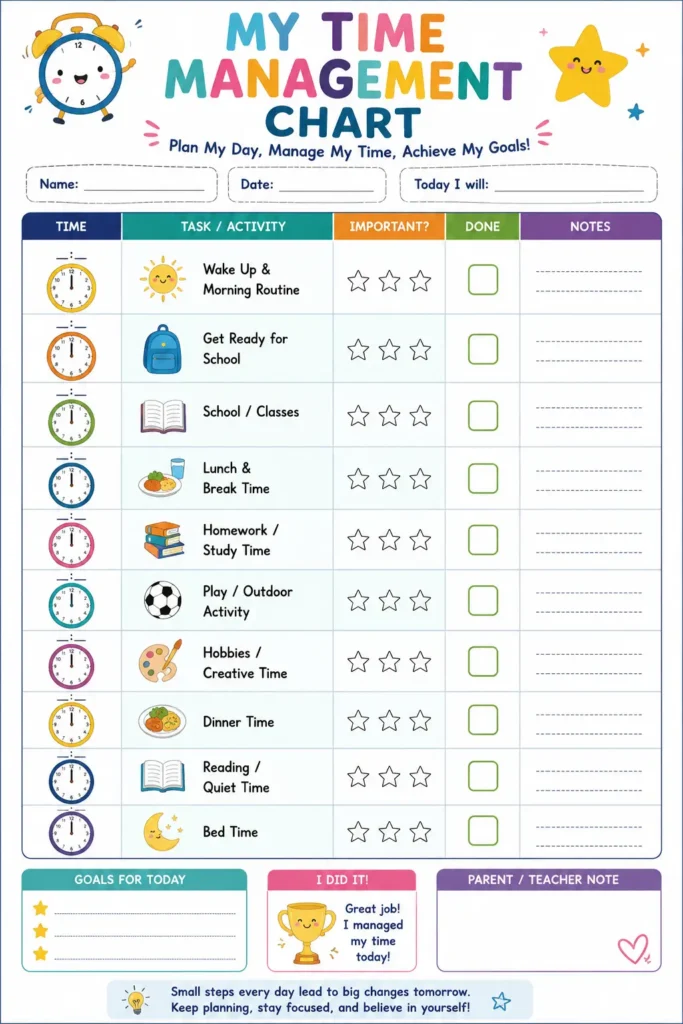
Free Kids Time Management Chart
Want to make this easier for your child? I created a simple free printable time-management chart that kids can use to plan their day, check off tasks, and build the habit of managing their time independently.
FAQs
How to help kids manage their time?
You can help kids manage their time by creating a consistent routine, breaking large tasks into smaller steps, and using tools such as visual timers, checklists, and planners. Give children age-appropriate responsibilities and gradually reduce reminders as they become more independent.
What age should I start teaching time management to kids?
You can start teaching your child basic time management skills at the age of 3-5 years. The focus should be on simple routines, transitions, and small responsibilities. You can introduce checklists, planning, time estimation, and prioritisation slowly as they will grow.
How do I help a distracted child manage time better?
If your child distracts easily, then don’t give long tasks; prioritise small and clear tasks. Use a simple checklist and visual timer for less distraction. Build the habit of self-management with a consistent routine and positive encouragement, instead of scolding or reminding many times.
What tools work best for teaching kids about time?
Visual timers, picture schedules, checklists, weekly planners, and digital calendars are good tools. Time-estimation games are also good to help your child understand how much time it will take to finish the task.
How much structure is too much for a young child?
For small kids, routines and structure are helpful, but managing every single minute of a day can be very structured. Add some free play, rest, and their favourite activities so that they will feel good.
Can a routine help reduce daily struggles around transitions?
Yes, a simple and predictable routine can make the transition easy for children. For small kids, picture schedules, visual timers, and First…Then…language may help to understand the transition.
One Last Reminder
Teaching your children about time management doesn’t mean following a perfectly planned schedule for them. Every day is not according to the plan, and that’s okay.
The real goal is that children understand what is necessary, how much time it will take to finish the task, and how to manage responsibilities.
You can start from routines and simple responsibilities. As soon as the child grows, you can give control for planning, prioritisation, and decision-making.
Your goal should be to make a habit of time management in your children, not to do everything perfectly.
Have you tried any of these time-management strategies with your child? Share what worked for your family in the comments.
Happy Motherhood:-)